So perfect. It captures the spirit of writing…
ReBlog: LET YOUR HEART…
So perfect. It captures the spirit of writing…
So perfect. It captures the spirit of writing…
 Jayzus Christ on a Moped, what a deeply disturbing book The Wasp Factory is. Sorry, but that was my initial reaction. And that is the best, most illuminating description I can give it. The story is a puzzle buried in all too vivid images that will give you nightmares and have you speculating whether the person standing beside you is a potential killer.
The Wasp Factory was Iain Bank’s first book, published in the ’80s, and is told in first person by the sixteen-year-old protagonist, Frank Cauldhame. I don’t do book synopses in my reviews because I don’t like to give away the story. What I can say is that Frank, to say the least, is not a particularly sympathetic character. Intriguing, yes. Compelling, yes. But likeable, understandable, absolutely not.
Surely controversial at its publishing and now, I can see why this book launched Bank’s career. I wanted to put it down. But I couldn’t. Every time I picked it up, I cringed at the idea of reading another page, but I kept reading, trying to uncover the clues to the enigma that is Frank Cauldhame. It made me squeamish, with it’s unashamed descriptions of animal abuse and more veiled descriptions of child abuse, and it made me wonder what kind of world could create such a person, which I suppose is what Bank’s was trying to achieve.
It also made me reflect on my own state of mind, on how I have become immune to human suffering, how I can breeze through detective and thriller novels that depict humans, adult humans, being abused, even tortured, in the most horrible ways and not be the least bit disturbed. And yet, let a protagonist, and hence an author, hurt a dog or rabbit– or sheep, for that matter –I become sick at heart, and I usually put the book down to never be picked up again. Because I can not imagine the cruelty, don’t want to imagine the cruelty of a human who can hurt animals and children. People who abuse animals and children are beneath contempt. No matter how mentally defective they are, how abused they themselves have been, I can find no sympathy for someone like that, and I personally hope there’s a special hell for those people.
So I wondered why an adult being abused does not affect me, at least not as drastically. Why I can read a grizzly detective novel and not flinch. The only reason I can come up with is that humans, most especially adult humans, are the primary source of cruelty in this world. I have lost all faith in human kind and see the abuse one gives another as a sad commonality in our world, whether by greed, stupidity, or mental defect. What I abhor is the abuse of something, someone who can’t defend itself.
Why did I keep reading? I don’t know. Frank’s actions and Bank’s descriptions disgusted me. And yet the writing compelled me to try to understand Frank. And I applaud Bank’s for not trying to make Frank a sympathetic character. It would have cheapened the story.
I certainly won’t read The Wasp Factory again. And I will think long and hard about reading any more of Iain Bank’s books. But I will give it 4-stars because it is a work of art. However horrible a picture it portrays, it is a work of art all too vividly portraying the human condition.
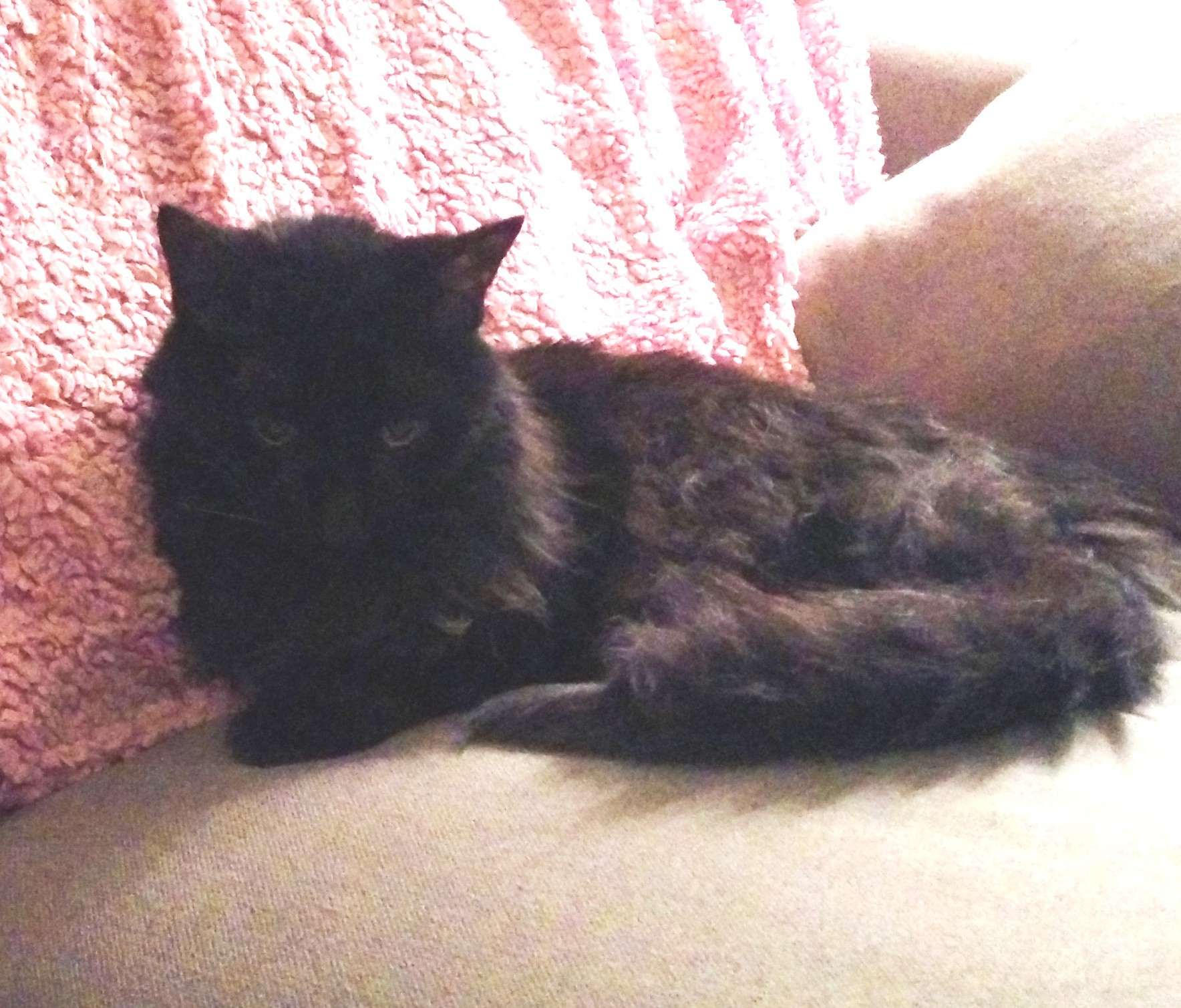 BlackBeary jerks awake from her eleventh nap of the day, frightened that she might still be at The Vet. [Cue ominous music.] Still drowsy she wonders: What if they gave her something, some awful drug to make her sleep? And what if her human left her there?
But the smell of the not-so-stinky, not-so-new sofa reassures her that she is at home and safe. Still she doesn’t rest easy. Every time she closes her eyes, the memory of the day’s events floods back like a really big flood, like a Katrina-big flood, like a flood of biblical proportions. Everything she fretted about all morning, all the time she was being starved, everything came true over the course of several hours.
First, weak from hunger, she was easily tricked into the nasty plastic prison. She was then thrust into a moving vehicle with a maniac– her human –at the wheel. The only saving grace of the trip was that, about two miles or so away from home, her human allowed her to come out of the prison. Another cat, a strange cat, no cat BlackBeary knows had obviously been in that awful mesh cage at some time since she last visited The Vet. [She’s pretty sure her human tried to clean it, but even five hundred gallons of Listerine can’t cover the smell of other.] So after much full-lung-capacity howling, BlackBeary’s human opened the awful prison and put BlackBeary on her lap where she rode during the trip to and from The Vet. Sadly, her human didn’t take the Miata which would have almost made the driving part almost okay. Instead they rode in the way-less-cool Mini because it was raining.
Once they were at The Vet, they were shunted into a claustrophobic blah-formica-clad room, painted in drab shades of beige that are probably supposed to be soothing. But aren’t.
BlackBeary searched every nook, every corner and cranny, although she still isn’t sure what a cranny is. There were no windows. The doors wouldn’t open, and the cracks beneath the doors were far too small to even shove a paw under, much less escape. And her human, well her human just sat there taking pictures, like that would help.
After a few minutes, Dr. “Hello, widdle pu’kin girl” Crow sauntered in, picked up BlackBeary and then commenced to talk to BlackBeary’s human as if BlackBeary weren’t even there. Dr. Crow, then took BlackBeary In The Back so that her human would never ever know all the insane, inhumane, Vincent Price-ish type torture they had in store for BlackBeary.
In The Back Dr. Crow’s assistants, Igor and Satan Jr., poked and probed and pinched and prodded BlackBeary, ’till she thought she would pass out from fright. They even pilled her with a little pill-gun. “Open wide widdle pu’kin girl…” Pop and the pill goes straight down BlackBeary’s throat. Aliens got nothing on Dr. Crow’s assistants what with their so-called thermometers and pill-guns. They even trimmed BlackBeary’s nails, like she’s not capable of doing her own grooming.
And when it was done, when all the torment was over, Dr. Crow put on her bestest, most no-I’m-not-evil smile and carried BlackBeary back to her totally-dumb, unsuspecting human.
Is it any wonder that BlackBeary’s blood pressure was sky high?
 For BlackBeary, those words, those gruesome words– THE VET –should be written in one of those old horror movie fonts, all red and blood-drippy. With ominous sound effects echoing in the background. The whole experience is torturous, like something out of a Vincent Price movie, starting with the food bowl being removed the night before.
Who thought up this evil torment?
It’s always the same. As if some demon straight out of hell has a record on repeat.
Last night, right before going to bed, BlackBeary’s human took up the precious food, leaving only a bowl of water. And then she tiptoed around sheepishly, as if the missing food bowl wouldn’t be noticed if she was quiet enough. As if it was just a normal day except there’s no food, not even any of the yucky dry food.
But for once, BlackBeary decided she wasn’t going to take it lying down, not even sort’ov laying down, even though a nap was preferable to what she had to do. When the loud, urgent meowing didn’t work, she realized it was time for drastic measures. So, she went into sweet-kitty, snuggle mode. After climbing up on the bed where her human was sleeping, she nudged her human until she woke. Then BlackBeary, in her most dangerous, most deceptive–ultra-ninja–guise, purred loudly, while giving her human sweet, sweet whisker kisses.
“I love you, Momma,” BlackBeary said in her softest kitty voice.
Her human reached over and petted her, but didn’t get up, didn’t even throw back the covers as if she might get up and fill a bowl to the brim with yummy, gravy-laden Fancy Feast. No, her human just burrowed down further under the covers, yawned and closed her eyes.
“I love you, Momma,” BlackBeary said more insistently.
To which her human did that stupid thing, she tried to speak Catish. The end result was that she mangled a bunch of words which made her seem ridiculous and somewhat repulsive. And for a moment, BlackBeary considered Momicide. After all her human was the one inflicting this anguish, this unnecessary suffering. The Vet certainly wouldn’t come to the condo and break down the door to get to BlackBeary.
No her human is the true evil behind this twice yearly event.
BlackBeary’s sure her human was planning on sleeping until the last-minute, but her plan was foiled. She got an on-call call from work at 5:30 AM. After that neither of them could go back to sleep, BlackBeary from miserable hunger, her human from insomnia.
BlackBeary is now pretending to ignore her human in hopes that her human will be groggy enough to fall asleep and miss their appointment, or even better, completely forget the visit to The Vet.
~ o ~
Will BlackBeary’s human fall asleep and miss the appointment? Will BlackBeary get a reprieve from… The Vet?
Stay tuned to see what happens…
You all know I have a love/hate relationship with NaNo and anyone who asserts that “real writers” write every day. I abhor the idea that “real writers” have discipline and can crank out a novel a year. Those tenets are judgment calls and patently not true. Or at least that’s what I tell myself. But even though I don’t believe that putting 1667 words a day to the page makes you a writer, at least not a good writer, I internalize those concepts. The idea that I’m a failure if I don’t get on the writing treadmill haunts me.
Until today.
This morning, while laying in bed [read as: being lazy on a Sunday morning], I read Storytelling, Slowed Down: On Writing Vertically which in turn pointed me to Gestation of Ideas: On Vertical Writing and Living. And an emotional light came on. I’m not such a lame writer after all. I have a process that works. For me. And I’m not the only one. Someone famous, someone considered a “real writer” wrote like I do.
Both articles point to a writing style used by Andre Dubus who cleverly, and eloquently, summarized my method of writing, long before I ever stated writing.
Dubus writes an idea in a notebook, and then leaves it alone: “I try never to think about where a story will go.” Planning is an act of control, and “I will kill the story by controlling it; I work to surrender.” Ever the Roman Catholic, Dubus first sees “characters’ souls.” Faces appear next, and that “is all I need, for most of my ideas are situations, and many of them are questions.” Only when Dubus sees the first two scenes is a story “ready for me to receive it.” Then he writes.
I don’t necessarily write an idea down, although I do have a small notebook that follows me around and has become a place for ideas about the story I’m working on. But many times those ideas are left behind, replaced by other ideas as the characters develop in my head.
During NaNo last year, 2013, I tried to make myself write, and I did, write that is. But instead of creating, instead of enjoying the process, I wrote, and I was miserable. What I wrote was miserable. One night I wrote the requisite 1600+ words, and you know what happened? My character, Sinclair, walked around. For 1600+ words, my character wandered around noticing things. It was crap. Because I didn’t know him, because he hadn’t formed yet. [I stopped after that, BTW, didn’t even try to finish NaNo.]
My characters tend to, like Athena leaping fully formed from Zeus’ head, only reach the paper when they are sure they want to exists. I don’t force them into situations. I create the idea of them in my head, and then I let them decide what they want to be, where they want to go, how they want to tell their story.
Good, bad, or indifferent, my writing style is like that. Now I know that I write vertically. And I suspect many writers do the same even though most of us are afraid to admit it because modern thought says if you write every day you are “good” or “real”. I don’t make those judgment calls. I don’t hold myself up as a shining example of the “good”. And it infuriates me that many do. I’m a real writer, and I don’t want to fit in a box. I don’t want to be like everyone else. I don’t want my writing to be another clone.
If writing every day works for you, that’s great, but it doesn’t make you a better writer or more real of a writer than someone who doesn’t. Just sayin’.
I’ll leave you with a long passage from Nick Ripatrazone’s post, Gestation of Ideas: On Vertical Writing and Living:
The folly of horizontal writing is that it convinces writers that fiction writing operates on a production model. If they simply sit at the desk and pound out page after page, the story will come. That might be true, but Dubus argues that such forced work creates a lot of “false” fiction. Curiously enough, by seeking to undermine the stereotype that writing is the result of inspiration, writers have fallen for the other, no less romantic opposite: that writing is factory work, and daily devotion is rewarded with final drafts. Both approaches are magical thinking. Vertical writing is no less work, but it is better work, work at the right time. It requires patience in the willingness to wait for a story to feel ready to be written, as well as the attention and focus necessary to inhabit the story once gestated.
 Sara Stark, Author