 I’m not sure how Nobel prizes are handed out. I believe it is based on an author’s body of work, not just on one book, but after reading Blindness, I’m unwilling to read any more of José Saramago’s books to find out if, in my opinion of course, he deserved the prize.
You can think what you want, that maybe I’m not intellectual enough to appreciate this book that “has swept the reading public with its powerful portrayal of man’s worst appetites and weaknesses-and man’s ultimately exhilarating spirit.”* To be very blunt, I thought this book, Blindness, was crap.
[Sorry, but crap is a funnily appropriate term considering Saramago’s obsession with shit.]
The books wasn’t compelling, and it could easily have been. The story was there, the storytelling was not.
I got past his “…long blocks of unbroken prose, lacking conventional markers like paragraph breaks and quotation marks…”** I struggled with how the point of view was all over the place: third person, head-hopping, first person, and the much confusing we used when Saramago interjected himself into the novel to have a short conversation with the reader, just in case you, the reader, weren’t smart enough to get the point. Near the end, even the dog got a chance to share its point of view.
I don’t have problems with difficult books. I’ve read Faulkner’s Sound and Fury, for goodness sake. I actually love Faulkner, and have read most of his books. I’ve read Dostoyevsky and Eco, James Joyce and Virginia Woolf. I’ve read Borges and Marquez. And I’ve read quite a few of the other Nobel Laureates, and that’s why I don’t understand how this book could have gained the following it has. These other authors, their stories engaged me as a reader. Blindness did not.
What bothered me was two fold.
One, I didn’t care about the characters, not really. [I told myself I was going to finish this book whether I wanted to or not, because I felt it had to have some redeeming qualities. It didn’t.] It wasn’t until I was about half-way through, when the doctor’s wife realized she had the scissors, that I actually got just a teensy bit interested in what might happen, but even that fell a flat, was too predictable.
The doctor’s wife would have been a great protagonist. The one person who can see in a city of blind people, how could that not be more engrossing than the “village chorus”**?
Did I mention that no one had names, that they were the first blind man and the doctor’s wife and the boy with the squint, etc? Maybe that was a way of being clever, of trying to show how blindness can de-humanize us, but it put distance between me and the characters. I didn’t connect with any of them, not even during the most horrific scenes.
And finally, regarding characters, it felt very obvious that this book was written by an old man. The women were two-dimensional, more so than the men. They were either whores or mothers or crazy, mostly whores. I really disliked his treatment of women, and not in the way you would imagine. The rape scenes and the surrounding text did not anger me because those scenes felt like possibly the only true to life scenes in the book. I just felt like I didn’t care about these women. They were all whores or crazy, and uninteresting whores and crazies at that.
Two, the book felt antiquated. I kept thinking it was written in and about the 1930-40s, until he would throw in a term like microwave or AIDS that made me stop and wonder too many things that kicked me out of the story.
Why were none of the women concerned about birth control or the spread of venereal diseases? With all the shit everywhere, why did none of the women get infections? [Old man writing?] Why did no one have a computer? And considering the problems the sighted doctor’s wife dealt with in the city, were there no flashlights with batteries? Really? In a city of blind people, you’d think flashlights wouldn’t be in high demand. Where were the malls? the REIs? Where were the religious fanatics? Surely someone in the hospital would have been shouting how this was all God’s will, that he was punishing sinners. Where were the drug addicts going through withdrawal? Why did no one in the hospital have cancer or diabetes or require special medicines? Did no one get a cold or have a headache? Did no one bring a bag full of drugs, over the counter or not? Why, out of 200+ inmates, did only one person bring a gun?
Did the blindness intentionally take the good, the old, the boring people first?
I just couldn’t relate to these people or the problems they were having. The people in Saramago’s world were more concerned with filth, with how everything was covered in shit and piss, than with realities. Saramago must have had some psychological problem with cleanliness. I get it. It smelled really bad and felt really bad, conditions were unsanitary, but if you say it more than three times you’re beating the reader over the head with it and showing the world your own obsessions.
He needed to show us what real people deal with everyday, things that would have been exacerbated by blindness. Things besides their bathroom habits.
Maybe a lot of these things were in the book but I just didn’t care enough to remember. Maybe they were too subtle for me to notice, or maybe I’m not intelligent enough to get it. Or maybe they were covered over with shit.
I gave this book two-stars because I did finish it. I didn’t want to, but I did.
* Blindness (Amazon)
** José Saramago, Nobel Prize-Winning Portuguese Writer, Dies at 87

 Jayzus Christ on a Moped, what a deeply disturbing book The Wasp Factory is. Sorry, but that was my initial reaction. And that is the best, most illuminating description I can give it. The story is a puzzle buried in all too vivid images that will give you nightmares and have you speculating whether the person standing beside you is a potential killer.
 A while back a friend–I think it was Kathleen–pinged me on FB to list ten books that have stayed with me over the years. I know the challenge is to just list them without really thinking about it, but that’s not who I am. I over think everything. No, really. I know I do.
 I read this in high school and was enthralled with Mr. Vonnegut’s writing. But it was the idea behind the book that kept evolving in my head that made me love this book. The story is funny and sad at the same time. It gave me perspective, if that is possible in a sixteen year old, on man’s stupidity, man’s willingness to destroy everything around him in the eternal search for more/better/happiness. And it helped developed my style of handling authority. I will never forget the ending, the image of Man’s final act of giving the finger to You Know Who.
 This book would be considered pre-teen now; back then it was just a kid’s book. I read it when I was nine, maybe ten. And it started my love of mysteries. The book blurb: “An abandoned baby. A locked trunk. A man called Finch. A stolen car ring. And a missing grandmother. Ronny and Greg Jameson didn’t realize that one girl could be so full of mystery. But that was before they met Evie Hollis.” What inquisitive kid wouldn’t want to read it?
 Another perseverance book, by one of my all time favorite authors. I love long complex sentences. Faulkner gives me something to chew on and has affected my writing style significantly.
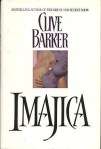 Last listed, but certainly not least, is Imagica. Take the complexity and depth of Straub’s and Gaiman’s books, the in your head style of Stephen King, and add a lot of grizzly, disturbing horror to it, and you’ve got Clive Barker. Imagica is 900 pages of earth-based, dark, violent fantasy which questions everything we know about the universe. About “themes such as God, sex, love, gender and death.”
 Sara Stark, Author