Flash.Fiction: Scruples

Photo Copyright K. S. Brooks

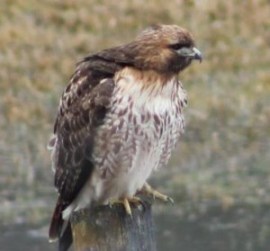
It’s that time again. The Indies Unlimited Flash Fiction challenge stirred something in me, made me want to address it. I grew up on a farm, way back before…

Anyway, the prompt is:

I called him Sigfried. He just flew down and landed on that fence post one day when I was plowing. He came every day after that. He just sat there and watched me. When I left, he left.

One day, I decided to go over and see how close I could get before he flew away. But he didn’t fly away.

I walked right up and touched him. That’s when I realized he wasn’t a real bird, but a very realistic robot. I could see the cameras for eyes; hear the tiny servos whirring as he twitched and moved. They had found me. After all this time they had found me again.

And this is my response to the prompt:

I knew I wouldn’t be able to hide forever, not after what I’d done.

You see, I used to work for CA, Corporate America, managed one of those industrial farms, produced of all kinds of unhealthy, profit heavy crops and livestock. You know the ones. Or maybe you don’t. We had a way of hiding the problems with our merchandise.

I did so well they promoted me to the research division, corporate nirvana for my line of work, where I got to “contribute” instead of just pushing product. What I didn’t know was that contributing meant leaving my scruples at the door, well, what little scruples I had left after working on a CA farm.

Sigfried was my idea. I envisioned a robot owl used to keep birds away from precious crops like cherries. The hawk design worked better, more streamlined. No, I wasn’t being altruistic or a “green” bean. CA’s about the bottom line. I knew we could make a mint, could destroy the competition just by using the Sigfried model to drive birds to non-CA farms.

What I didn’t envision was how Sigfried would be used like a drone to drop hazardous chemicals into the water supply of competing farms, not just hurting their business, but putting them out of commission completely. Salting the earth, no less.

I ran with what little scruples I still had intact. But not before I leaked damaging information to the press. Then I hid, in plain sight. On a farm.

Until today.

Gluing the Frog Back Together

IMG_20140809_111612Did you ever have one of those moments when you’re trying to glue something back together and you realize that you’re missing a piece?

Last week, I had a new sofa delivered, and in the process of moving things so the delivery guys could get in the door, I broke a frog figurine. Yes, I said it. It is a frog figurine. A Jim Shore frog figurine. And quite expensive. And because I love all things whimsical, it is one of my treasured items.

So I’m trying to glue it back together, but I realized last night that I don’t have all the pieces. That a couple of large pieces are hiding somewhere just out of sight. I’ve moved furniture and looked under the fridge. Nada. Still looking.

For me, writing is like that. I don’t write in chronological order. I usually don’t write in any type of order at all, unless it’s a very short story. And sometimes the hardest part of writing for me is finding that piece that has somehow slipped under the refrigerator or is hiding behind the sofa, mentally that is.

This past Thursday, I was thinking about a prior job and the people who worked there. And there she was, my inspiration for Sinclair’s mother. I won’t say her name. Anyone who really knows me will likely guess, but it could be messy if  I announced to the world that X is the model for Y. Especially since Sinclair’s mother isn’t a great/nice/likable person.

This means I have one more piece of the story, a huge piece that I’ve been struggling with, a piece that’s been hiding behind the chest of drawers. I have a mental sketch of her character and possibly her physical appearance. No, it won’t be her exactly. That would be cheating. But it gives me a good start on her character.

Now if I can just find the other pieces, I can glue this frog together.

Dear Gen(re) Letter

genre2

I’m having an identity crisis.

I’ve been reading My Temporary Life by Martin Crosbie. On Amazon, I was surprised to see that it’s listed as a romantic suspense novel. If I twist my brain around enough, I can see that it could potentially be a romance, but from what I’ve read, I’d place Mr. Crosbie’s book in the mainstream/literary fiction genre, not romance. So far, it reads more like a well-written coming-of-age story.

But back to me. After thinking about it for a good while, I pinged some of my friends, ones who’ve read An Untold Want, and asked if it should be classified as a romance. Every one of them came back with a yes.

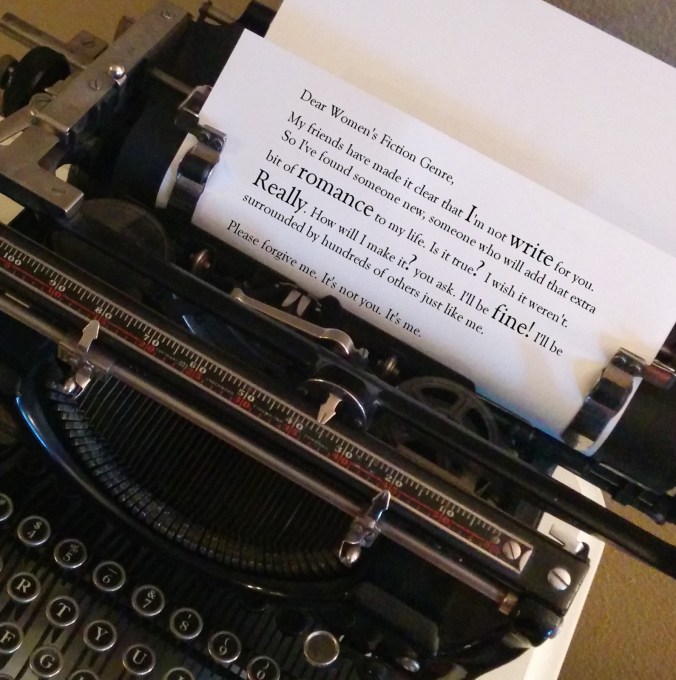
So now I’m having an identity crisis. [If you didn’t notice the large text / question marks in the photo, it reads I write romance? Really?] I don’t read romance novels. I’m not saying they’re bad or lesser. I’m just saying that they’re not my book of choice. So how is it possible that I wrote a romance novel?

After a bit of soul-searching, I went out to the Romance Writers of America [RWA] web site, and read up on what makes a novel a romance.

For a novel to be considered a romance, there are two requirements. There must be:

1) A Central Love Story

This means that the main plot involves two individuals falling in love and struggling to make the relationship work.  I went back and asked my friends, and they indicated that, in their opinion, the relationship between Maggie and JD is the main plot. For me the romance drives the plot, but I feel like the plot centers on her self acceptance and that JD is the transport mechanism, the primary person who helps make it happen. Everyone else sees the self acceptance as a nice side effect of working out the relationship.

2) An Emotionally Satisfying and Optimistic Ending

Okay. An Untold Want does fit that requirement. It almost didn’t, but — and maybe this is the point where I went off the Women’s Fiction rails and headed down the Romance track — I wanted to tie it up nicely. I wanted Maggie to be happy, to have that optimistic ending. After such as struggle, I wanted her to find the place where she belongs, where she feels safe and comfortable. Maybe it was wishful thinking on my part, that if I can’t have it at least she can. I wanted Maggie to be different, to be not me. To end up better off than I did.

I’m sure that I’ll force myself through some flaming mental hoops before it happens, but I’m positive that sometime in the not too distant future, I’ll be changing the genre on An Untold Want. It’s not a difficult process, at least not technically. And a move like this will potentially open my writing up to a whole new group of readers.

But first, I need to convince myself that I wrote a romance novel.

ReBlog: Influenced by Kurt

I posted this on my old blog back in early 2012, for the anniversary of his death, I think. Anyway, I thought it was worth reblogging. Kurt Vonnegut is still one of my favorites.

~ o ~

I’m also reading Sirens of Titan by Kurt Vonnegut.  I had forgotten how much I love his prose, his wit (the dark humor), and the way he constructs sentences.  I read Cat’s Cradle and Slaughterhouse-Five way back in high school (and yes, they did have printed books back then — on paper, not stone).

Kurt Vonnegut, Jr., photo dated April 8, 1992. Doug Elbinger, Elbinger Studios.

I suppose that Kurt V has been somewhere in the back of my head, all these years, setting an example, pushing the gallows humor that sort of pops up in my work, but the thing that really got me thinking about it was, while reading Sirens, I kept thinking I would write that sentence exactly like that. Now that I’m reading him again, I realize–and I’m going to test this theory, by re-reading Cat’s Cradle and Slaughterhouse-Five just to make sure that the prose is similar–that he, not Bill (Faulkner) influenced my style of writing.  I write very much like Kurt Vonnegut. Well, my style is like his. I won’t say I’m as good a writer, because that would be stupid.

Needless to say, I’ll be studying his books to see how to improve my own writing.

I’ll leave you with a few quotes.

From Cat’s Cradle:

–  Anyone who cannot understand how useful a religion based on lies can be will not understand this book either.

–  Beware of the man who works hard to learn something, learns it, and finds himself no wiser than before… He is full of murderous resentment of people who are ignorant without having come by their ignorance the hard way.

–  Of all the words of mice and men, the saddest are ‘It might have been.’

From Slaughterhouse-Five:

–  All this responsibility at such an early age made her a bitchy flibbertigibbet.

–  The skyline was intricate and voluptuous and enchanted and absurd. It looked like a Sunday school picture of Heaven to Billy Pilgrim.

–  And Lot’s wife, of course, was told not to look back where all those people and their homes had been. But she did look back, and I love her for that, because it was so human. So she was turned into a pillar of salt. So it goes.

–  Like so many Americans, she was trying to construct a life that made sense from things she found in gift shops.

And from Sirens of Titan:

–  The bounties of space, of infinite outwardness, were three: empty heroics, low comedy, and pointless death.

With that said, how can you not enjoy an author who can invent the chronosynclastic infundibulum. I’d urge you to read Sirens of Titan, but just in case you don’t, this is from A Child’s Cyclopedia of Wonders and Things to Do:

“Just imagine that your Daddy is the smartest man who ever lived on Earth, and he knows everything there is to find out, and he is exactly right about everything, and he can prove he is right about everything. Now imagine another little child on some nice world a million light years away, and that little child’s Daddy is the smartest man who ever lived on that nice world so far away. And he is just as smart and just as right as your Daddy is. Both Daddies are smart, and both Daddies are right.

Only if they ever met each other they would get into a terrible argument, because they wouldn’t agree on anything. Now, you can say that your Daddy is right and the other little child’s Daddy is wrong, but the Universe is an awfully big place. There is room enough for an awful lot of people to be right about things and still not agree.

The reason both Daddies can be right and still get into terrible fights is because there are so many different ways of being right. There are places in the Universe, though, where each Daddy could finally catch on to what the other Daddy was talking about. These places are where all the different kinds of truths fit together as nicely as the parts in your Daddy’s solar watch. We call these places chronosynclastic infundibula.

The Solar System seems to be full of chronosynclastic infundibula. There is one great big one we are sure of that likes to stay between Earth and Mars. We know about that one only because an Earth man and his Earth dog ran right into it.

You might think it would be nice to go to a chronosynclastic infundibulum and see all the different ways to be absolutely right, but it is a very dangerous thing to do. The poor man and his poor dog are scattered far and wide, not just through space, but through time, too.

Chrono (kroh-no) means time. Synclastic (sin-classtick) means curved towards the same side in all directions, like the skin of an orange. Infundibulum (in-fun-dib-u-lum) is what the ancient Romans like Julius Caesar and Nero called a funnel. If you don’t know what a funnel is, get Mommy to show you one.”

First Draft / First Chapter … Maybe?

Finally, I’ve been doing some writing on my WIP (work in progress).  I have bits and pieces of it all over the place because I don’t write in chronological order, but the story has to start somewhere. I think this is where it starts. For today, this is where the story starts.

I would love feedback, with the understanding that this is a first draft,  and all that implies. Things could change. This piece could be thrown out completely. Or it may be the most brilliant thing I’ve ever written. Probably not, but writer’s have to think that way, or we’d never commit anything to paper.

~ o ~

How was I to know that this woman was a bigger liar than I was, that she used the same tricks I used just on a different audience?

IMG_20140608_134432

It was the tail end of a cold, gray day, the misting rain insisting I pack up and go home early. But the cupboard was empty. Literally. I needed the money more than I needed an escape from the dreary Seattle winter. So, when the woman stopped in front of my stall, I did my job. I looked up at her and asked if she’d like a reading.

Most days back then, if the weather wasn’t too abysmal, I sat at the north end of Pike Market on a blanket under an umbrella telling people what they needed to hear. This woman, though, wasn’t one of my normal customers. She surprised me when she paused and then sat down on my blanket, curling her knees under her and settling in. I thought she must be desperate to lower herself like that, literally. My usual customers weren’t quite so… refined. Seattleites, especially ones perusing the market, rarely dressed as if they’d just walked from the pages of Harper’s Bazaar.

I could tell she was uncomfortable, physically at least, from her constant weight shifts. She was so thin that with each shift I imagined her hip bones grinding into the sidewalk. The blanket provided no cushioning, but what did I care? I laid the sand tray between us, and using a stick off a fir tree in our yard, I drew a circle in the sand, a medicine wheel. The readings I did weren’t true to any Native American tradition, but all the new-agey-tourists who visited the market didn’t seem to notice or care.

I had her draw four stones from a cloth bag, and I placed them at the elemental points of the circle. It didn’t matter which stones she drew, I read people’s body language and then told them what I thought they needed to hear. That was my gift after all, telling people their personal truths. Maybe I should have paid more attention to my own personal truths. But at this point in my life, that’s neither here nor there.

I then shuffled the spirit cards, had her cut them, and drew the card off the top.

“Rabbit would say it’s time to overcome your fear,” I said.

Rabbit fit this twitchy woman perfectly, all soft and fear-eyed, nostrils quivering as if afraid of even disturbing the air around her.

I told her it was time to face her fears, as if she had any real fears. For heavens’ sake, she was bookended by her stuffed-full Nordstrom’s bag and an overly large, funeral home-ish bouquet from a stall down the way. But the real tell was her somewhat sensible and obviously expensive shoes. Sitting on the ground all day gave me the perfect opportunity to notice and critique people’s shoes. Any shoes that ugly had to be expensive, fabulously expensive.

My brother Jeryl would have said I was being unkind. He often mused aloud, as if hinting to me or trying to annoy me, that he couldn’t understand how someone so close to him, how his mirror image could be so angry all the time when he was always so calm and easygoing. I would just shrug and remind him that he wasn’t the one sent away to be raised by rabid nuns. He got to stay home and have a normal life.

I wasn’t just being unkind. I was angry at this woman. She appeared to have every opportunity at a good life, a well furnished life, and here she was shivering, rabbit afraid. I wanted to shake her, tell her to take one of her platinum cards and buy herself a new life, but my income depended on me being empathetic, even if I didn’t feel that way.

What could she possibly need to worry about? Certainly not where her next meal was coming from. Not that I did either. If I had to, I could depend on Father to help out, but I didn’t want to be dependent, not on Father. Not on anyone. It was bad enough that I lived in the guesthouse without paying rent. Jeryl still lived in Father’s house. He wouldn’t move away. So I stayed, in the guesthouse, but I would not allow Father to fund the rest of my life. I would starve first.

The woman seemed to bring out the worst in me, and I wanted her to leave. But I also wanted her money. So I spent the hour with her, reassuring her that everything would be alright. After all, she wasn’t the one with a young man stalking her.

Of course, I didn’t mention to her that this young man had been watching my every move for the past week or so. The reading was all about her. I always gave the customer my full attention during a reading. They got their money’s worth. But with him watching me, I felt like Rabbit, soft, weak. Easy prey. Like her. And it made me mad. At her, but mostly at myself.

That day he sat at a table in the little Turkish coffee shop across the street from my spot at the market. He tried not to be obvious about it, but even the old biddy in the next stall had noticed him as he strolled by for the fourth or fifth time. On the sixth or tenth time, she rolled her eyes at me and mouthed, “It’s him again.” I had no idea who he was or what he could possibly want from me, but it had become obvious that I, not the old biddy, was the focus of his attention.

The two days before, I had snuck out, walking down through the market to Pike and then back around on First, just to avoid walking past him. But that day, I decided Rabbit was right. It was time to face my fear.

But I didn’t get that chance.

After the reading was done, ‘Fraidy Rich Bitch pulled herself up from my blanket, dusted herself off, grabbed her Nordstrom’s bag and bouquet and headed his way. Something made me watch her. Sure enough, halfway across the street, she waved to him.

And he waved back, not a cheery wave like hers, more of an acknowledgement.

My mind started spinning out a hundred different scenarios. It was obvious that they knew each other.

As I stored the sand and tray in a plastic baggie, I watched her stride up to his table, watched her bend and kiss him on the cheek before sitting down across from him. Watched them lean in toward each other as if whispering some arcane secret.

With a snap, I shook out my blanket—my eyes never leaving their table—and, for once not bothering to be neat about it, squashed the blanket into a tight bundle that would fit into my backpack. Anger swelled inside me, smothering me. The woman hadn’t been afraid of anything. It was all an act. Her shivering, her twitchiness was likely an adrenalin rush coming from the pleasure in the lie.

For the price of a reading, I was sure she had found out more about me than about herself. She didn’t need me to reassure her, to tell her about herself. She knew herself all right. Being able to act like that, to put on someone else’s face took a lot of self-control. And guile. In that moment, I hated her. She made me look the fool. And she was right there, right in front of me, sharing the joy of her deception.

What did they want? To make me look ridiculous? If so, it worked.

My face burned with the pure stupidity of my actions. I took the woman at face value. She used me, more than I used her.

And just as I decided to leave, to just walk away and try to forget, I noticed something between them change. I dropped my backpack on the ground and took a few steps closer.

His body language, something I had become familiar with the past few days, changed. When he got up and went to the counter, gone was the lazy stroll. At that distance, I couldn’t see that well, but I would have bet money he was frowning as he strode to the counter. His body was rigid as he waited for the coffee. His gait hardened when he returned and placed a cup of coffee in front of the woman.

She clasped his hand before he could pull it away, said something to him as he sat. The stiffness went out of him. Pulling his hand from hers, he slouched down into his chair. As if he’d given up, as if it was too much effort to maintain the anger or fear. Or whatever he was feeling.

She, in turn, leaned even further, palms flat on the table on either side of her cup, and said something that, of course, I couldn’t hear.

His chin dropped, and then she sat back and laughed. She was laughing at him? No, I was sure she was laughing at me.

Someone shouldered past me, and said, “Hey, if you’re just going to stand there gawking, don’t block the aisle.”

I stepped off the curb and eased out into the street between two parked cars.

Gesturing with her hands as if telling a funny story, she was doing a lot of talking. She made a circle as if drawing it on the table, and then laughed again. He said nothing.

And then, and then he turned and looked right at me.

I froze, rabbit still, for a moment and then backed up onto the curb, my heel catching the uneven concrete. I nearly fell backwards. Someone said, “Watch it.” Someone else said, “You okay?” But I didn’t see who.

Then the woman also turned to look at me. I felt my throat close up as she smiled at me, a Red Riding Hood wolf-like smile.

I swung around, ran to my stall, grabbed up my belongings, and fled up the sidewalk toward the bus stop that would take me home.

10 Reasons I Want to be an Author

I recently saw one of those fun posts on Facebook, you know, the type with a funny picture and a quote, or something like that.  This one was Why I Love Being an Author. It made me think about why I want to be an author. Well, let me restate that, I want to be an author making enough to support my style of living which does not imply that I would need to be the next Stephen King.

These are my ten reasons why I want to be an author. If you disagree, you can create your own list.

(1) I get paid for exercising a creative outlet.

Let’s face it, I’m bored with my Corporate America job.  I’ve been doing it for 25 plus years now, and it hasn’t fulfilled a single dream, other than it has provided me the funds to fulfill some short-term dreams. I started writing because I needed a creative outlet. Now I’d like to make what was once just a creative outlet my full-time job.

(2) I can work from home, in my jammies, with bed-head if I want. Or anywhere.

I live less than twenty miles from work, and most days my commute is an hour each way, and that does not include the time to get ready for work.

And when I get to work, I sit in a cubicle. I started out my career in Corporate America in an office, but Corporate America has deluded itself into believing that cubicle farms are the way to engender productivity. Or at least that’s the take away from the rah-rah “what’s good for the company” speeches, from the “this is a good problem to have” lectures. I haven’t found this to be true. Most days I feel like I work in one of those chicken coops, you know, the corporate farms’ coops with tiny cages stacked ten deep in which the chickens at the bottom are literally smothering in the poop from above.

Plus, I can live anywhere and still be an author. I could move out of the city or move into the inner city. I could have a small house in the woods or on the beach. The options are limitless when you aren’t tied to an office.

(3) I can work in the middle of the night. Or take a nap, whenever.

bb_01_2

I am not a day person. Ask my co-workers how lovely it is to work with me in the morning, especially after only a few hours of sleep, which happens more often than most understand.

Like Ms. BlackBeary, my cat, I could take a nap any time of the day, maybe two.

(4) No need for a psychotherapists. (Most days.)

Writing is a great release, a great way to address issues without having to confront people.

I’ve had a lot of unnecessary trauma in my life. Most writers have had f’ed up lives. I think that’s what makes their writing compelling. Because of my particular dosage of f’ed-up-ness, I try to dodge confrontation if at all possible, which makes it seem, if you don’t look too closely, that I’m an easy target. Not true. At least, not for long. I have a limit, and if you cross the line I’ve drawn in the sand, then I got nothing for you. But some people can’t let it go–whatever it is–and have tried to back me in a corner or use me. If I ask you to leave me alone, I mean it. If you cross that line, not only will I fight back in real life, I’m sure a character a lot like you will end up tortured, maimed, or even killed in one of my stories.

(5) I can kill people. And get paid for it.

No, I’m not a hit man. But I am known for having my characters die in strange and sometimes frightening ways. I’m pretty sure that I scared some of the people in my writing classes.

For me this is a type of internal release valve. It keeps me from acting on my fantasies of revenge. It keeps me from harming those who have caused me serious injuries. Just like with (4) I can use my imagination mingled with my memories to heal my wounds, sometimes by inflicting imaginary wounds on others.

Have I scared you yet?

(6) I get paid to lie.

I get to make up stories for a living. When I was a kid, way down in South Georgia, accusing someone of telling a story was a nice way of calling them a liar. But now, that’s what I do. I tell stories. Although now, some of my stories are closer to the truth than I’d like. As Stephen King said, “Fiction is the truth inside the lie.”

(7) I get to create my own worlds.
–direct corollary to (6)

Don’t like Seattle, Atlanta, or New York? Doesn’t fit the story? Well then, I can invent my own world/place/city. If it needs to be so different that it won’t even fit on this planet, then I can write science fiction or fantasy. I get to use my creativity to make a world for my use only.

(8) Likewise, I get to create people.
–another direct corollary to (6)

I named this blog Literary.Schizophrenia because I invent people, people who become real in my head after a time. When I first start on a story, I come up with the idea of a character and then I put them in bizarre situations. At that point, I just follow them around to see what they’re going to do. Some are interesting, some not. The interesting ones get to hang around.

(9) Reading novels is considered research.

Good advice from one of my favorite authors:  “Read everything–trash, classics, good and bad, and see how they do it. Just like a carpenter who works as an apprentice and studies the master. Read! You’ll absorb it. Then write. If it is good, you’ll find out.” –William Faulkner

(10) Authors are glamorous.

Well, sort of. Authors are interesting and smart and …

Authors can move around easily, much more easily than someone in a soul-sucking, cubicle-squatting, 9-5 job.  And so, authors often tend to end up as the protagonist in novels or movies. Which makes it seem somewhat glamorous to be an author.

Just think of all the movies that feature an author as main character: Wonder Boys, Barton Fink, Misery, The Dark Half, Secret Window, Midnight in Paris, Deconstructing Harry, Finding Forrester, Capote, The Hours, Naked Lunch, Evidence of Blood and a bunch of others. Don’t believe me? Check out Films about Writers at Wikipedia

And apparently authors have all the skills required to be detectives. Jessica Fletcher made Cabot Cove, Maine the murder capital of the world. I still think she was committing all the murders and was smart enough to blame it on someone else.

To say the least, authors are one special group.

And I want to be a member of that group.

ReBlog: Copyright Infringement: A Warning to all Authors

My novella, Couillon, is there, linked to Kobo, with which/whom I do not have a contract. My novella is also available for “download”. General eBooks on Twitter, @General_EBooks, says they’re just doing free advertising. I disagree. Please check your books to see if they’re listed at http://www.general-ebooks.com/. I’ve also reported copyright violations, TWICE, with no feedback whatsoever.

Short of bringing in a lawyer, the best thing I can do is spread the word.

Tim Baker's avatarblindoggbooks

I would like to share a letter sent to me by a fellow independent author, who wishes to remain anonymous, about a website claiming to be promoting independent authors, when in reality it appears that they are offering free downloads of the work of dozens of us.

If you are an author, independent or otherwise, I urge you to read this letter and investigate the site yourself. Find out if your work is posted there and take appropriate action to have it removed, or, at the very least, make sure you are willing to grant permission to the site owners to list your work.

Making money as an independent author is difficult enough without pirating sites giving our work away under false pretenses AND without our permission.

Please share, tweet or reblog this post in order to spread the word through the independent author community and, hopefully, put some pressure…

View original post 703 more words

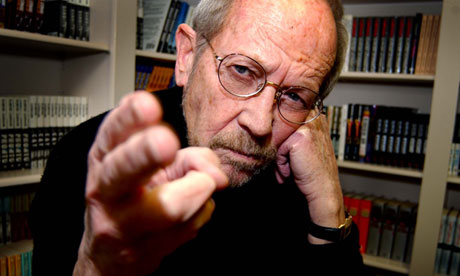
ReBlog: Elmore Leonard: 10 Rules

I’m on board with all of these except the one about the prologue.

I do agree that if there is a prologue it should be short and not a necessary part of the story as many people skip over them. In my novel, An Untold Want, I have a prologue that introduces the tone of the book. The reader won’t be missing any facts if they skip it, but it’s a nice bit of prose, even if I do say so myself.

~ o ~

They say the day Goodie Lowrey’s husband died thousands of crows converged on Jacob’s Creek, blackening the noonday sky and drowning out her screams in a tumult of wings and incessant chatter. They say only the crows bore witness to the curse Goodie placed on Agnes MacAllister and that they’ve carried the secret for these two hundred years.

They say any man foolish enough to fall under the spell of a MacAllister woman deserves his fate.

Maggie MacAllister tries not to listen to what they say, to the whispers as she walks past, to the nuance of their words that turn a nicety into an accusation, but a walk through the family cemetery is all the proof she needs they might be right.

Brian Marggraf's avatarIndie Hero

Elmore Leonard: 10 Rules

Among all the lists of writing rules and advice, this one ranks high, in my opinion. Simple, yet so important.


  1.  Never open a book with weather.
  2.  Avoid prologues.
  3.  Never use a verb other than “said” to carry dialogue.
  4.  Never use an adverb to modify the verb “said”…he admonished gravely.
  5.  Keep your exclamation points under control. You are allowed no more than two or three per 100,000 words of prose.
  6.  Never use the words “suddenly” or “all hell broke loose.”
  7.  Use regional dialect, patois, sparingly.
  8.  Avoid detailed descriptions of characters.
  9.  Don’t go into great detail describing places and things.
  10.  Try to leave out the part that readers tend to skip.

My most important rule is one that sums up the 10.

If it sounds like writing, I rewrite it.

 * Excerpted from the New York Times article, “Easy on the Adverbs, Exclamation Points and Especially Hooptedoodle”


Some…

View original post 25 more words

Character.Interview: Beryl Ward

Name: Beryl Ward

Gender: female
Age: 27
Home:  upper Queen Anne, Seattle, Washington
Ancestry: Native American (mother) / German (father)
Appearance: It’s obvious that Beryl gets her looks from her mother’s side of the family. Her caramel coloring, round face, almost almond-shaped eyes and high cheek bones betray her Native American heritage. She wears her hair long and straight, usually pulled back in a loose pony tail or braided due to its thickness. Her eyes are a dark chocolate-brown that matches her hair. She has no distinguishing facial features, no tattoos, no scars.
Favorite color: black, of course
Typical Outfit:  She appears to be the epitome of Seattle Grunge, with her jeans and a plaid button down over a tank top, worn laceless Vans on her feet. Her outfit looks like a hodge-podge of clothing she found at Value Village.

Today, I’m interviewing Beryl Ward, the protagonist in my latest–yet to be named–novel. Thank you, Beryl, for spending some time with me, for letting me expose you, who you are to potential readers.

[Beryl shrugs.]

So what do people call you?

[rolls her eyes at me]

Beryl

No nickname?

Nope.

You live on Queen Anne, right? Must be nice, living in that part of town. Lots of beautiful old mansions up there.

If you say so.

You’re not very talkative.

You’re the one who wanted to do this interview. Wasn’t my idea. I agreed, but I don’t have to be overjoyed about it.

Were you born there?

Yes. My father has owned that house since before I was born. I live in the guesthouse out back now, though.

You don’t live in the house with your father. May I ask why?

You can, but I don’t think it’s any of your business.

Okay. Let’s see… [check my list of questions] Who are the people you’re closest to?

That would be my brother, Jeryl.  And maybe Mr. Denny across the street. He’s blind. Mr. Denny, not my brother.

Funny. Beryl and Jeryl.

We’re twins. I guess my parents thought it would be cute. 

[another eye roll]

And your parents, you didn’t mention them when I asked about people you’re close to.

You’re right. I didn’t.

Would you care to elaborate?

Not really, but I know you’ll just keep asking if I don’t. My mother died when I was very young, five or six maybe. I can’t even remember now. To say that my father and I aren’t close would be an understatement. Let’s just leave it at that.

This Mr. Denny, how long have you known him?

He’s lived across from us since I can remember. I think he’s one of the Dennys, you know, the family that founded Seattle.

What is it you like about him?

He listens to me.

[almost laughs]

Well, I guess he has to since he’s blind. But, you know, he treats me like a person. He’s old, and loves to tell me stories, like my…

You stopped. You were going to add something.

I was going to say like my mother.

[pauses]
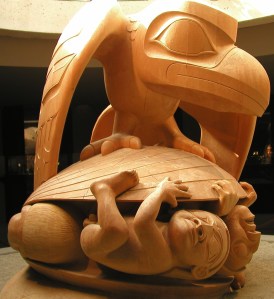
My mother told us stories when we were little. Me and Jeryl, she told us stories about Raven, the trickster. About Otter and Orca and Mink. Native American stories. If we were bad she’d tell us that The Woman of the Woods–a giant cannibal woman–was going to get us. But she never let us be afraid for long.

Was there any story in particular that she told often?

There is the Nootka legend of the twins, the Kwe’kustepsep who changed the world. I guess I remember that because of Jeryl and I being twins. But if I remember correctly, she always started her stories–  Once, many many years ago, there was a Nootka chief who had a beautiful daughter, that was how most of my mother’s stories began.

[pauses again, turns away and looks out the window]

She didn’t mean to imply that she was good-looking or even a handsome woman—I came to understand that, only later—but she understood that the best stories are always about the beautiful daughter.  She knew that girls are capable of getting into so much more trouble but as storytelling goes, an ugly daughter, especially a child of a chief, was not worth considering.

[still looking out the window, pauses, this time for so long that I almost ask another question]  

I am the ugly daughter of the beautiful daughter of a Nootka chief.  I wanted to be beautiful, but I only ended up being troublesome. 

Beryl, you’re not ugly. 

It’s not what you see. It’s what I see.

[pauses, turns back toward me]

Let’s talk about something else

Okay. [pause to look at my notes] So what do you do for a living?
IMG_20140608_134306

I have a stall down at Pike Market. I draw medicine wheels and read spirit cards.

Medicine wheels?

What? I have to teach you everything? Let me Google that for you.

[big sigh]

In general a medicine wheel is a physical structure. I create a very small one in a sand tray with stones to act as the elemental points. It’s an introspective way of connecting with, with–  That whole circle of life thing new-agers are so crazy about. You know, the elements and totems and such. I figured out a way to make money off of it. It’s not true to Native American beliefs, but it’s good enough for a bunch of wannabes.

That sounds a little cynical.

I give the customer what they’re looking for, a feel good session. Basically, I listen to their problems. And say supportive things. I think I actually have a gift for knowing what people need to hear. And for them, it’s cheaper than a psychotherapy session. I only charge $60 an hour.

Do you get a lot of customers?

Enough to support myself. 

But you live on Queen Anne.

I live in my father’s guesthouse, okay. I would have moved away a long time ago, but Jeryl won’t move out of the big house. So, I stay there. And no, before you ask, I do not have to pay rent. But I pay for everything else I need, food, clothing, stuff like that.

I’m really not trying to be confrontational. Just to prove it, if you were [laugh] a tree, what kind of tree would you be?

Wow, that’s original. Who are you? Barbara Walters?

Aren’t you a little young to know who Barbara Walters is?

[no response]

Alright, let’s try something else, something that will hopefully give us a view of who you are. What’s your totem animal, or your astrological sign, or whatever you follow?

Leo. And my totem animal changes at times, depending on what I’m trying to accomplish. But usually it’s Raven.

Leo is interesting, all fiery and loyal, fierce and egotistical at times. [smile] I know because I’m a Leo too. But most of us know a bit about astrology, enough to recognize the signs or how to find more information if we want it. Because I don’t know as much about Native American mythology, I have to ask what it means to have Raven as your totem animal?

Raven is the keeper of secrets. But is also the trickster. With Raven, you  never know if what you’re seeing/feeling is real. You never know what you’re going to get.

Okay, how about another one, one a bit more esoteric this time? What smell do you associate with the kitchen from your childhood?

[scowls, and then very slowly smiles]

Pancakes. My mother used to make pancakes for me and Jeryl. His favorite– our favorite, blueberry pancakes. 

That sounds nice. So how about another easy one? What’s your favorite novel?

I don’t read.

May I ask why?

You may.

[sighs]

I’m dyslexic. Reading is difficult for me. But if I had to guess, something I’ve had to read in the past, I’d say Jane Eyre.

Ok. Just for me, let’s do a silly Barbara Walter’s type question. Please?

[sighs and then nods]

If you were a rock star, who would you be?

[gives me a look of long-suffering]

Ummm. Lady Gaga.

You don’t seem all that flamboyant, at least not from physical appearances. You remind me more of Sarah McLachlan, well with Native American coloring. So why Lady Gaga?

I want to be like her, unafraid of being who I am and showing it. Maybe she’s not like that at all, but she projects that.

So I’m about to wrap this up. Is there anything you would like everyone to know about you, something I haven’t asked already?

Yeah, tell them to mind their own business. No one likes their life being on display for everyone to dissect. Your life must be pretty boring if you have to examine mine so closely.

Alrighty then. So do you have any questions for me?

I do. Why are your words in bold and mine aren’t. What, do you think you’re more important than I am?

Well, I did create you.

Sure, keep telling yourself that.