Very Inspiring Blogger Award

Today, I received notice from VikToryArch that I was nominated for the Very Inspiring Blogger Award for my 3 Biggest Reasons It’s Good to be Indie post.


image21


First let me say thank you, VikToryArch.

But with the nomination comes the duty to display the award and pay it forward to fifteen other bloggers whom I admire. I choose not to enforce the chaining part of the requirements on those I nominate. It’s their decision whether to continue the chain. Or not. I’m perfectly happy either way.

This is just my way to say thank you for entertaining me and inspiring me.

So here we go.

These links will take you to sites by friends and authors who inspire me.

Old friends

Lisa Poisso

(my editor and friend)

Scott Wyatt

Martin Hengst

including his latest post:

5 Tips for Success as an Indie Writer

S.A.Molteni’s And So It Begins…

Gisela’s Straightforward Blog

Melissa Bowersock’s Wordlovers

Indies Unlimited

which hosts a ton of authors and great information

and

Master Koda

And some new friends

Bob Mayer’s Write on the River

JRBarker 101

Books are Delicious!

toofulltowrite

Often Clueless, Always Shoeless

(stole her idea for character interviews)

Daily (w)rite

Elodie Under Glass 

(not about writing, but great place for writing ideas)

and #16 — yes, I’m cheating — VikToryArch (back’atcha)

3 Biggest Reasons It’s Good to be Indie

I’ve been thinking a lot lately about this desire to be chosen by an agent/publisher. There are nights when I beat myself up, when I wallow in self-pity [I am notorious for that, but at least I’m self-aware] because I couldn’t get an agent to represent me and my novel. To have chosen to go down the indie route because I couldn’t get an agent at times feels like a cop-out, like if I’d just tried a little harder then I would have been good enough.

But during those dark nights, when the wallowing gets extreme, I tell my self the following:

I wrote a good book, a quality book, and no matter what these agents think, it’s worth publishing.

And then I think, why would I want to go down the traditional publishing route anyway? I’ve never been known to embrace the norm, to fit in the box whether at work [ask my managers, if you don’t believe me] or in relationships. Or in writing. I don’t want to be normal. I want to be more, better. I want to live my life, not a life that fits someone else’s standard. I want to live outside the box. To be unique, authentic. Different.

So why this desire to be normal publishing wise? We’re told, time and again, that vanity press, that self publishing is only done because you’re not good enough to be a real author. But I’ve found that isn’t true. I’ve read Indie books that surpass many of the traditionally published books on the market. And yes, the indie world still has a lot of growing to do, but that doesn’t diminish my work. I’m an individual and should be treated as such.

I’ve found that there are three reasons that it’s good to be indie, publishing and lifestyle wise:

(1) I get more.

Somehow, even though I’ve managed to annoy my management, sometimes to the point that they loathe me, I’ve always worked hard and have a reputation of delivering what I say I’m going to deliver. And I make a very good salary in my big Corporate America life-style. But I also have the satisfaction that I won’t sell out, won’t deliver my soul up for better pay or some manager’s fleeting approval.

So why would I sell my soul to a publisher? Why would I want to get 7% of my royalties, which is what the traditional publishing route would net me, when I can get up to 70% of the royalties? Especially when with a traditional publisher, I’d have to do most of the work anyway. Gone are the days of the big promotions for new authors. So my book wouldn’t do any better, sales wise, than it is now.

If I was a purely business oriented person, I’d say that the traditional route ROI is crap. I write a book. I set up my social presence and much of the advertising. I do all the things you, Mr. PublishingHouse, don’t want to do for a new author. And you give me 7% of the sales? That’s not a smart investment.

(2) I control everything.

Yes, I am a control freak, but in this case, it’s a good thing. My manuscript isn’t sitting at the bottom some agent’s or some publisher’s I’ll get around to this one day pile. No delays due to re-formatting or waiting for an interior design person, one with low enough status to rank working on a newbie’s book. I control how fast my book goes to market.

I control the number of words, the editing, the title, the cover, the design. I control what percentage of the royalties I’ll get by deciding how the book will be distributed.

There are no long-term, dead-end contracts. If I want to pull my book from X distributor, I can do that.

I control everything, but mostly I control how successful I am.

(3) I own the rights.

Does this need explaining? In the case of publishing, if I pitch the story to a movie house, it’s mine to do so. And if I do so, I get the proceeds from the sale, not a small portion of them. There are a hundred other examples. Basically, if a publishing house has the rights to my book, I control little or nothing.

In life, I own my success and failure. I own my soul.

Not one of these reasons indicates that an indie writer will have an easy time of it, that they will be an instant success, that they don’t have to edit or produce quality work. Writing is hard work. Why would anyone think that publishing is easy?

But what the reasons do indicate is that we newbie authors should get more for the work we’re doing, we should look for the best ROI.

So you see, it’s good to be different, to be indie.

Authors: Established vs Newbies

I’ve been following the Amazon/Hachette melee, and maybe because I’m a new author, I am leaning toward Amazon’s view of the world. No, I’m not in favor of monopolies, and Amazon is heading that way, but I’m also not the least bit happy about the way new authors are treated by the traditional publishing industry.

My view of the world is that there’s a double standard when it comes to established, well-known authors versus new authors.

Some of it I can understand.  I can see that a publisher may not want to take a risk on a thousand page novel by a new author, one which may tank after they’ve made a major investment in physically creating a tome that size. Most new authors start out with a novel significantly less than 125K words [approximately 400 pages], and so I had a hard time selling An Untold Want to an agent. In fact, I never was able to get an agent to represent me. Several specifically said they wouldn’t even consider a manuscript with more than 90K words from a new author. One agent told me to cut it down to 85K words and then come talk to her. She wasn’t offering me a contract up front. No, she was just saying she would possibly consider it if I cut my novel in half. I passed on that offer.

Some of the issues I don’t understand, like quality of writing. Awhile back I did a review of The GoldFinch. If a newbie author had submitted The Goldfinch to a major publishing house, let’s just say Hachette, that author would have been laughed out of their office.  The book is long and convoluted and badly edited. And yet, the publisher is pushing it. And it won a Pulitzer. Yes, it has some beautiful prose and is an interesting story, but it would never have seen the light of day, a book that won a Pulitzer would never have been published if it had been written by a new author.

Agents and publishers expect newbies to come to them with a complete, fully edited manuscript. With a social presence already in place. From what I’ve read, in multiple articles from well respected news outlets, publishers now only focus on supporting their big draw authors, the J.K. Rowlings and James Pattersons of the book world. If I were to get a contract with Hachette today, I’ve no doubt that I would have to do a large majority of the advertising myself.  So for a whopping 7% of the sale price [yes, that’s what new authors tend to get from publishing houses], I would get to do 70% of the work, not including writing the novel.

When I couldn’t get an agent, [Your book is too long. Your book doesn’t fit our genre. Your books just wasn’t for us.] I went down the indie route. By self publishing with Amazon, I get 70% of the royalties and I own the rights to my book. Yes, I did all the work, but the ROI is significantly better than if I’d gotten an agent and gone down the traditional route, say with Hachette.  There are tons of agent/publisher horror stories out there. My favorite, the one I tell myself at night when I’m trying to boost my ego about why an agent wouldn’t want my book, is that many authors finally get an agent only to have their books placed at the bottom of a huge pile of I’ll get around to this later.

The Huffington Post posted a great article that sums up the indie versus traditional situation: Are There 5 Reasons to Stick With Major Publishers? No, There Are Zero Reasons

Just to be fair, there is a down side to self publishing. Indie books are still considered substandard. All self published authors are lumped into a huge ball of what appears as mediocrity. Those who do the work to polish their novels are pulled down by those who don’t. Even I shy away from indie authors because I’ve paid for too many books that were badly written. I wrote about this phenomenon in my post Do Yourself a Favor: Edit Your Book. Too many new authors write what is in essence a first draft and then rush to publish it. As one web article said, we are drowning in indie books, and my take is that many of them are sub-par.

With that said, the best reason to be an indie author is that I’m in control of how successful I am. I can edit or not. I can create a great cover. Or not. I can do what I want, but what I do is in direct relation to how successful I am. I am not waiting on someone else to promote my book.

Flash.Fiction: Time and Tide

Yes, it’s another Indies Unlimited Flash Fiction contest entry.  It’s unusual for me to do two so close together, but when I looked at the picture, I couldn’t resist.  I’m planning a vacation to an island in the San Juan’s and the picture made me think of what might be while I’m on vacation.

I read through the other entries, and I think I have put a unique spin on the story.

This week’s prompt is:

Photo Copyright K. S. Brooks

That kid in the picture is my little brother, Andy. In 1987, he got carried away by an undertow at this very beach. The authorities never recovered his body.

I took this picture of him yesterday, when he walked up out of the water as if nothing had happened.

And this is my story based on the prompt:

For just a moment I’m sure I’ve lost my mind. The boy, it’s Andy, my twin, but it can’t be Andy. Andy died. When we were kids, Andy died. The undertow took him from us, never to be found again.

I draw near, wary that a grownup approaching a young boy might look suspicious. But I can’t stay away. I have to see this boy. This ghost I’ve just captured on film.

As I suspected, a woman rushes up, grabs the boy’s hand, and asks me what I’m doing. The boy pulls away and runs further up the beach.

“It’s just… He looks like my brother, Andy. When we were kids.”

Never taking her eyes off the boy, the woman must sense my sadness.

“That’s funny.” She smiles, nodding toward the boy. “His name’s Andrew. But we call him Andy. For some reason, his father was adamant he be called Andy, wouldn’t consider anything else.”

“Daddy, Daddy,” the boy shouts holding up a starfish. “Look what I found.”

The father looks up from where he sits on the beach and waves at the boy.

There’s something about the father. I move closer.

The man stands, picks up the boy, and my heart skips a beat. Can it be? My brother, Andy, fully grown, my twin, stands before me. I walk up to him.

Hugging the boy safe, he extends his hand. “Name’s George. Can I help you?”

My mouth drops open. “Were you adopted?”

He frowns. “How’d you know?”

Ask the Author: Where did you get the idea for your most recent book?

Goodreads goodreads_icon_100x100-86359711e159b24740d60683e79eec45recently added a feature called “Ask the Author”.  To get the author started, the Goodreads Team listed some typical questions. Prompts like “How do you deal with writer’s block?” and “How do you get inspired to write?”

I thought I’d start with an easy one. “Where did you get the idea for your most recent book?”

Everyday I see something or read something, and I think, that would be a great story. For awhile I kept a list of story ideas, but it got to the point it was frustrating to note down another idea and not do anything with it. I’ve sat in movies and halfway through thought, if this doesn’t end the way I think it’s going to end, then I’m going to write that story.

With Couillon, I was under pressure to write a short story for a literary fiction class I was taking. On the web I had recently seen an image of Jesus and Mary painted in DayGlo colors, and in my head, I immediately saw that painting hanging in a voodoo shop in New Orleans. I love all things mystical and spooky. That image of the voodoo shop gave me the theme and led me to write the first section [20 pages or less for the class], the scene where Janice purchases the voodoo doll. I later turned that short story into a novella.

An Untold Want had no such immediate inspiration, no ah ha moment. I had finished my literary fiction class and helped form a short-lived writing group with some of the members of said class. They were all working on A Novel, and I thought I should be working on a novel too. Again, I love anything arcane. But for me, a novel can’t just be about witches or spooky stuff. Yes, there are a lot of novels out there about witches and ghosts, but I don’t write urban fantasy. I’ve tried to write genre, because it sells better, but I just don’t think that way when I’m writing. Then I thought about Alice Hoffman’s Practical Magic, and I decided to try my hand at a story like that. It ended up being nothing like Practical Magic, except it has witches, but that was the key factor in how An Untold Want started. I pulled the last name from one of my favorite songs, Ode to Billie Joe, but spelled MacAllister differently. I took the setting from Midnight in the Garden of Good and Evil. You don’t get spookier than Savannah. And from those key factors, I built a small town and an unhappy woman who is a bit too much like me.

For my latest project [working title: Twin Story], I decided that I did not want to invent another small town. It’s a lot of work to create a world, from the street grid to the geography [Is it a swampy area? What are the trees/flowers like? What does it smell like? What are the buildings like?] to the town’s personality/attitude. I’ve lived in Seattle long enough that I thought I’d try my hand at writing a novel based in Seattle. But my novels have to have that bit of the esoteric, or they wouldn’t be mine. So I decided to incorporate Native American mythology into it.

But the key factor, what really started the project was an article I read in the Weird News on some newspaper website. I can’t tell you what the news story was because that would give away a large part of the story I’m working on. But those three things — Seattle, Native American mythology, and weird news — gave me the premise for my new novel. I’ve since read a lot about Native Americans, about the residential schools [which disturbs me greatly], about the different tribes, and about the myths especially those of Raven. I didn’t realize how different the Pacific Northwest tribes are, but I’ve grown to love the Native American mythology. I’m still not sure how I will pull it all together, but I’m working on it.

With that said, I should be writing the book instead of writing about it. I wish it were as easy as writing a blog post.

Flash.Fiction: The Ghosts of Northgate

Every week, Indies Unlimited has a flash fiction contest, and every now and then, the image and prompt calls to me. I love all things grizzly and creepy. If you’ve read my novella Couillon, you’ll understand. I think I scared some of the people in my writing classes because in my short stories, someone always gets killed in a disturbing way.

This week’s flash fiction prompt was the picture included here and a prompt:

Photo Copyright K. S. Brooks

Northgate Sanitarium was an extension of the state prison system. The facility specialized in  experimental treatment of the criminally insane. Some horrible stuff went on there.

Abandoned in the 1950s, the old building has been linked by rumor to a few recent disappearances.

I had just gotten my first job as a journalist, working for the Northgate Observer. I thought it would make a good story to spend the night in the old sanitarium. Back then, I guess you could have called me a skeptic…

This is my response, my story:

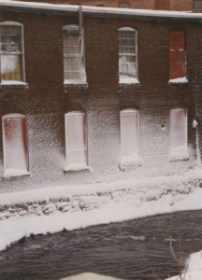
Snow had fallen the night before, covering the campus and dampening any sounds from the surrounding areas, making the outing feel isolated and forbidding. And just downright cold. I followed along behind the shivering research students as they investigated the Northgate lockdown area, you know, the ward where the real crazies were kept. Now that the facility was closed for good, these students had keys to even the most appalling parts of the building.

I kept asking them questions, trying to steer them in the right direction without literally pointing out that they didn’t have a clue, but the arrogant little prats just ignored me. I could show them things. Scary things. Real things. After all as a reporter I had investigated Northgate, way, way back before some of them were born. They should at least pay attention. Should at least give me some of the respect I deserve.

This group wouldn’t even be here if only I’d been allowed to write the article I wanted to write, an article exposing the experimentation done on the unwilling. Unwilling, insane criminals, yes, but still unwilling. In my original research, I had uncovered atrocities that needed to be exposed. Doctors allowed to do whatever in the name of science. Doctors allowed to maim and mutilate. And kill, all in the name of science. If only…

If only I could just get these students to listen, I’d show them where the bodies were hidden, where my body was buried with all my notes.

Do Yourself a Favor: Edit Your Book

IMG_20140627_165856Yesterday, Lorraine Devon Wilke was a guest blogger on Indies Unlimited. After starting out with the Amazon/Hachette debate, her post, The Persistence of Self-Publishing Stigmas and How To Transcend Themmoved to a topic that’s a constant source of irritation for me.  Lorraine’s opinions on why indie-authors are typically thought of as sub-par was spot-on, and you can read her opinions for yourself.

I agree with Ms. Wilke, but not because I’m an uppity my-writing-is better-than-yours author. No, I agree with her because I’m an avid reader, and I have pulled down far too many badly written indie books, rife with typos, poor grammar, and just plain bad writing. So many that I have a “Don’t Like” folder on my Kindle so that I won’t forget the author’s name. So many that I now shy away from most authors I haven’t read before. I paid for many of those poorly written books. But even if a book is free, I’m investing my spare time reading your work. And if you’re one of the ones who is putting out these obviously unedited books, you won’t get my repeat business. Sadly, it doesn’t affect just you. Actions like this reduce the chance of readers investing in other unknown, indie authors’ work.

Do yourself a favor, okay. Edit your book.

~0~

First of all, the idea that you can’t afford an editor is ridiculous. If you don’t barter, beg, or pay for an editor, chances are you won’t ever have the funds to pay for an editor because after reading your first book, no one will ever buy another one. If you can afford a $5 Macchiato every day, then you can afford to save up, budget, and pay for an editor. At the absolute very least have beta readers. There are a ton of groups on Facebook alone where people are willing to read your book, free of charge, and comment on it.

Do yourself a favor: let someone else decide when it’s ready to release.

 ~o~

That leads me to the idea that you can finish the last chapter on Monday and have your book available on Amazon on Tuesday. It is enticing, and it is prompting many new authors to “rush to publish”. Even though the rush to publish idea is a perfect metaphor for today’s society, it’s a bad, bad, bad idea. Did I mention it’s a bad idea? Have you not heard the term shitty first draft? If you publish right after finishing the last chapter, then you are publishing a first draft. I’d even bet that you haven’t gone back and re-read your book, probably not even once. This is not even a money issue. This is an arrogance issue, a stupidity issue. What is the big hurry? If you really believe that you can finish your book and publish it right away, you probably aren’t going to be losing any awards/money/readers by waiting a month or a year, because books like that don’t get awards or tons of royalties or loyal readers.

Do yourself a favor: wait, re-read your book, several times.

 ~o~

With many new authors, especially those who are still totally in love with their own work, there’s this attitude that their work is as good as it’s ever going to be and they may as well publish it now. Wrong. Every now and again, I go back and re-read the work I wrote in my first writing classes, and even though I see the potential in my writing, I also see what a huge pile of crap my writing was at that time. And at that time, I thought everything that came out of my pen was pure genius. It wasn’t.

Do yourself a favor: attend a class, join a critique group, learn your craft, polish your work.

~o~

I could go on and on about poor workmanship, bad writing, and ridiculous cover art. [gimp is free, folks, figure out how to use it to create an attractive cover.]

But I still wonder why some new authors believe that they don’t have to do the hard work, that just telling a story is enough?

Is it possible that someone has told them that their work is the greatest writing since [fill in the blank]? It’s possible. Which leads me to my biggest indie-world pet peeve: coercing your friends into writing 5-star reviews. If that person is your friend, and if you’re a good writer, then you should be able to take an honest, constructive critique. Several close, long time friends have given me a 3-star rating because literary [women’s literary] fiction isn’t a genre they enjoy. I’m okay with that. Personally, I never give a 5-star review unless I’ve read the book multiple times, or I think that I would want to read it again.

Untitled

While perusing books on Amazon, the first thing I do is to look at the review graph. If that graph shows anything other than an inverted triangle, then I don’t even bother. There is not a single book that’s been published that everyone likes. So don’t try to bullshit me that your book is so good that it has fifty 5-star reviews and nothing else.

On the flip side of this review/ratings coin are the people [usually indie authors themselves] who always give 5-star reviews, no matter how bad the book is. Maybe they want all the other authors to like them. Or possibly, these people think if I give Sara a 5-star rating, she’ll return the favor. That is not going to happen, and not because I like being a bitch. If I’ve read your book all the way through, and I see problems, then I feel it’s my responsibility to respect you and your work, and tell you the truth. This is not a mutual admiration society. We are authors. Stand up and be honest. Give constructive criticism.

Do yourself a huge favor: accept constructive criticism, use it to make your book(s) better.

~o~

Finally, I’ve re-read this post at least five times. There may still be typos because it’s hard to proof your own writing. You see what is supposed to be there. And I’m a terrible speller. But, no one can say that I didn’t spend the time trying to make this post as good as it can be.
To Sleep, Perchance to Dream…Wait, I’d be Happy to Just Sleep

Today, thUntitlede WordPress Daily Post mentioned “sleep procrastination”.  I don’t think I procrastinate at night. I know that my brain’s not on a 24-hour schedule. There are nights when I’m literally awake all night, and I’m well into the next day before I get sleepy.  I’ve been to several doctors and every damn one of them gives me the same lecture. Don’t read in bed. Don’t go to bed until you’re sleepy. Don’t this… Don’t that.

And you know what, these platitudes do not work for me. I’m a night person living in a day-oriented-work world.

I tried the “stay in the living room until your sleepy” bit. I fell asleep on the sofa, and as soon as I got up to go to bed. I was wide awake, again.

I tried turning off the light and just laying there, waiting to fall asleep, because everyone knows that if you just turn off the light, you’ll fall asleep. Problem is that when I turn off the light before I’m sleepy, my mind starts doing mental gymnastics, thinking about everything I ever did that was wrong or bad or stupid. If that isn’t enough to wake someone up, I don’t know what is.

I haven’t written in a while because by the time I’m ready to write, usually around 2am, I’m supposed to already be asleep or at least winding down, because I have to get up in a few hours and be functional in a 9-5 soul-sucking job. So at night when it’s time to go to bed, I climb in bed, and I read, and read, and read, until the Kindle is falling on my face. [BTW, the Kindle doesn’t hurt nearly as much as a hardback hitting me in the face.] But my doctor says that reading in bed is bad for me. I call foul. At least I get to the point where I can sleep if I read in bed.

I am not everyone else. I don’t believe that one size fits all, and I especially don’t believe there’s only one solution to a problem.

The solution to my problem is a job that’s flexible enough for me to sleep when I can. Something like an author. I just gotta get there.

http://dailypost.wordpress.com/dp_prompt/sleepy-time/

Finding Time to Write

Most of us who are just starting out as authors have to hold down a job that pays the rent.  So when do we find time to write?

During the week, I find that by the time I get home from my computer geek 9-5 job that my brain has turned to cheese, and not the good cheese. No, by then, my brain is more like the cheese you find at the back of your refrigerator, the hunk of Gouda or Camembert–hard to tell at that point–you don’t remember buying. So I tell myself that it’s okay to sit on the sofa like a giant wilted celery stalk, that it’s okay to do nothing, but I feel guilty about it.  See, I’ve already broken my resolve not to have to produce.

Anyway, as I’m sitting here feeling guilty about not writing, I tell myself that I’ll write this weekend.  But you know what, my weekend is the time when all the stuff gets done, the house cleaning and shopping and the big to-dos like re-sealing the grout in the bathrooms or installing the new range hood.

What I need to do is find some discipline. I need to write for an hour everyday. But discipline, like patience, is not one of my virtues. Procrastination and self-deception, now those virtues I revel in.

IMG_20140608_135745 (2)The problem is that Beryl–the protagonist in the novel I’m currently writing, or not currently writing if truth be told–has been bugging me lately.
And Sinclair, the antagonist and pseudo-love-interest, has decided he doesn’t want to be a teacher at a Seattle community college. No, he has changed professions. Sinclair’s new profession fits more with his personality, or maybe his new profession is a large part of what shaped his personality.

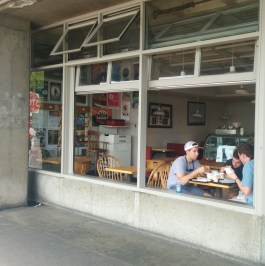
Last weekend I even went to Pike Market to scope out the territory, where Sinclair sits as he watches Beryl. And you thought I just dumped a couple of random pictures into this post. The one jpeg is potentially where Sinclair would sit [a coffee shop across the street from the end of the market] and his view from said coffee shop.

IMG_20140608_135725

So I ask myself, does this count as writing? Does building characters and walking around, photographing their life, their microcosm count as writing?

For now, I’m telling myself yes, this does count as writing. I’m building the characters in my head, building their stories. And to be honest, this is the fun part of writing. I love creating people. I love investing enough of the thought process in them that they become real, at least in my head. I can see both of them, can hear their voices, can feel their pain. Because you know if I write it, it isn’t going to be some fun beach read.

Did I mention that self-deception is one of my virtues?

Rekindling the Fire

IMG_20140608_215810

Today, I went with a friend down to Pike Market. There they have this wonderful little witchy shop called Tenzing Momo. I go there every time I’m at the market, but because I was with a friend, I hadn’t planned on getting a tarot reading today. Having known me for a very long time, my friend suggested that I go ahead and get a reading, that she could easily entertain herself for half an hour in the market.

If you’ve ever had a card reading, or two, you know every reader has his/her own style. Add into equation the fact that I read cards, not professionally, but for fun, and, well, I just never know what I’m going to get. I’ve had some really good readings and some really silly — I won’t say bad, because, just  because — readings. Today’s was good.

As Tansy, in An Untold Want, says reading tarot cards is akin to pagan psychology. The cards are there to help the recipient of the reading get in touch with his/herself. The reader is (or should be) more of a guide.

We started out today with the reader asking my birth sign, Leo. She was surprised, said that it felt like I was more of a Water sign than a Fire sign. I don’t know that much about astrology, but I went with it. We talked for awhile about possible reasons. She said that I was allowing the Water in me to dampen down my Fire. What she said felt true. For a long time, I’ve felt like I have to suppress my personality to fit in. To make others happy instead of myself.

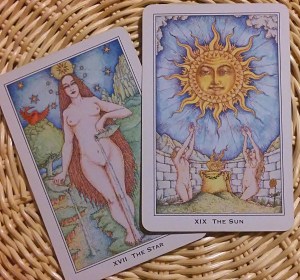
She then laid out the tarot cards. The beginning card was The Star and ending card was The Sun. In the picture I’ve posted, the cards are from the deck I use, the Nigel Jackson Tarot.  The reader at Tenzing Momo used a different deck. Sometimes the deck matters. Most times it doesn’t.  But even if you know nothing about tarot cards, you can probably surmise that these are both good cards.

There is a ton of symbolism in each image. So many things that can be interpreted, from the card number to the colors, to the elements represented, to the animals or scenery in the background. When you read the cards, all these things can be taken into account, or the reader can go with a general idea of what the card means to them. That’s why the deck matters sometimes. Anyway, I’ll give you the short version. In general The Star represents inspiration and renewed hope, while The Sun is all about the power of the light after a period of darkness. About regaining the fire.

About regaining the fire that I’ve quenched for too long worrying about what others want or need, putting their needs ahead of mine.

The reader said one other thing that really stuck with me. She said that I don’t have to produce anything. Not unless I want to.

I know it sounds silly that this was such a revelation, but sometimes I need someone to hit me over the head with it before I see what’s right in front of me. Lately I’ve been feeling so weighed down, worrying about this or that. Worrying about a promotion or a raise or just how I appear. [I have a lot of Maggie MacAllister in me, or vice-versa.] Worrying that I won’t be able to please everyone. Worrying that I can’t be all things to all people.

What I really need to do is write. Not because I have to. Not because I should do it. Just because I want to. Because it’s something that I enjoy, something that I do for me.

***

If you’d like to know more about Tarot cards/readings, this is a good place to start:  http://www.ata-tarot.com/resource/cards/

Or if you just want to play around with a reading or three, without having to buy a deck of cards or pay for a reading, this is a really good site:  http://www.facade.com/tarot/