Do Yourself a Favor: Edit Your Book

IMG_20140627_165856Yesterday, Lorraine Devon Wilke was a guest blogger on Indies Unlimited. After starting out with the Amazon/Hachette debate, her post, The Persistence of Self-Publishing Stigmas and How To Transcend Themmoved to a topic that’s a constant source of irritation for me.  Lorraine’s opinions on why indie-authors are typically thought of as sub-par was spot-on, and you can read her opinions for yourself.

I agree with Ms. Wilke, but not because I’m an uppity my-writing-is better-than-yours author. No, I agree with her because I’m an avid reader, and I have pulled down far too many badly written indie books, rife with typos, poor grammar, and just plain bad writing. So many that I have a “Don’t Like” folder on my Kindle so that I won’t forget the author’s name. So many that I now shy away from most authors I haven’t read before. I paid for many of those poorly written books. But even if a book is free, I’m investing my spare time reading your work. And if you’re one of the ones who is putting out these obviously unedited books, you won’t get my repeat business. Sadly, it doesn’t affect just you. Actions like this reduce the chance of readers investing in other unknown, indie authors’ work.

Do yourself a favor, okay. Edit your book.

~0~

First of all, the idea that you can’t afford an editor is ridiculous. If you don’t barter, beg, or pay for an editor, chances are you won’t ever have the funds to pay for an editor because after reading your first book, no one will ever buy another one. If you can afford a $5 Macchiato every day, then you can afford to save up, budget, and pay for an editor. At the absolute very least have beta readers. There are a ton of groups on Facebook alone where people are willing to read your book, free of charge, and comment on it.

Do yourself a favor: let someone else decide when it’s ready to release.

 ~o~

That leads me to the idea that you can finish the last chapter on Monday and have your book available on Amazon on Tuesday. It is enticing, and it is prompting many new authors to “rush to publish”. Even though the rush to publish idea is a perfect metaphor for today’s society, it’s a bad, bad, bad idea. Did I mention it’s a bad idea? Have you not heard the term shitty first draft? If you publish right after finishing the last chapter, then you are publishing a first draft. I’d even bet that you haven’t gone back and re-read your book, probably not even once. This is not even a money issue. This is an arrogance issue, a stupidity issue. What is the big hurry? If you really believe that you can finish your book and publish it right away, you probably aren’t going to be losing any awards/money/readers by waiting a month or a year, because books like that don’t get awards or tons of royalties or loyal readers.

Do yourself a favor: wait, re-read your book, several times.

 ~o~

With many new authors, especially those who are still totally in love with their own work, there’s this attitude that their work is as good as it’s ever going to be and they may as well publish it now. Wrong. Every now and again, I go back and re-read the work I wrote in my first writing classes, and even though I see the potential in my writing, I also see what a huge pile of crap my writing was at that time. And at that time, I thought everything that came out of my pen was pure genius. It wasn’t.

Do yourself a favor: attend a class, join a critique group, learn your craft, polish your work.

~o~

I could go on and on about poor workmanship, bad writing, and ridiculous cover art. [gimp is free, folks, figure out how to use it to create an attractive cover.]

But I still wonder why some new authors believe that they don’t have to do the hard work, that just telling a story is enough?

Is it possible that someone has told them that their work is the greatest writing since [fill in the blank]? It’s possible. Which leads me to my biggest indie-world pet peeve: coercing your friends into writing 5-star reviews. If that person is your friend, and if you’re a good writer, then you should be able to take an honest, constructive critique. Several close, long time friends have given me a 3-star rating because literary [women’s literary] fiction isn’t a genre they enjoy. I’m okay with that. Personally, I never give a 5-star review unless I’ve read the book multiple times, or I think that I would want to read it again.

Untitled

While perusing books on Amazon, the first thing I do is to look at the review graph. If that graph shows anything other than an inverted triangle, then I don’t even bother. There is not a single book that’s been published that everyone likes. So don’t try to bullshit me that your book is so good that it has fifty 5-star reviews and nothing else.

On the flip side of this review/ratings coin are the people [usually indie authors themselves] who always give 5-star reviews, no matter how bad the book is. Maybe they want all the other authors to like them. Or possibly, these people think if I give Sara a 5-star rating, she’ll return the favor. That is not going to happen, and not because I like being a bitch. If I’ve read your book all the way through, and I see problems, then I feel it’s my responsibility to respect you and your work, and tell you the truth. This is not a mutual admiration society. We are authors. Stand up and be honest. Give constructive criticism.

Do yourself a huge favor: accept constructive criticism, use it to make your book(s) better.

~o~

Finally, I’ve re-read this post at least five times. There may still be typos because it’s hard to proof your own writing. You see what is supposed to be there. And I’m a terrible speller. But, no one can say that I didn’t spend the time trying to make this post as good as it can be.
IU Featured Book Promo

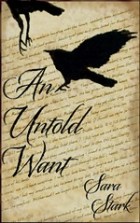
My novImageel, An Untold Want, was listed today as a feature book on the Indies Unlimited website. The IU folks are great to work with, and if you’re serious about being an indie author or are at a loss as to where to find like-minded people, I think you couldn’t do better than the Indies Unlimited group.

They have helpful pages on everything from how to write a book blurb to how to format jpgs.

Take a look for yourself, starting with my featured novel:  IU Featured Book: An Untold Want

To Sleep, Perchance to Dream…Wait, I’d be Happy to Just Sleep

Today, thUntitlede WordPress Daily Post mentioned “sleep procrastination”.  I don’t think I procrastinate at night. I know that my brain’s not on a 24-hour schedule. There are nights when I’m literally awake all night, and I’m well into the next day before I get sleepy.  I’ve been to several doctors and every damn one of them gives me the same lecture. Don’t read in bed. Don’t go to bed until you’re sleepy. Don’t this… Don’t that.

And you know what, these platitudes do not work for me. I’m a night person living in a day-oriented-work world.

I tried the “stay in the living room until your sleepy” bit. I fell asleep on the sofa, and as soon as I got up to go to bed. I was wide awake, again.

I tried turning off the light and just laying there, waiting to fall asleep, because everyone knows that if you just turn off the light, you’ll fall asleep. Problem is that when I turn off the light before I’m sleepy, my mind starts doing mental gymnastics, thinking about everything I ever did that was wrong or bad or stupid. If that isn’t enough to wake someone up, I don’t know what is.

I haven’t written in a while because by the time I’m ready to write, usually around 2am, I’m supposed to already be asleep or at least winding down, because I have to get up in a few hours and be functional in a 9-5 soul-sucking job. So at night when it’s time to go to bed, I climb in bed, and I read, and read, and read, until the Kindle is falling on my face. [BTW, the Kindle doesn’t hurt nearly as much as a hardback hitting me in the face.] But my doctor says that reading in bed is bad for me. I call foul. At least I get to the point where I can sleep if I read in bed.

I am not everyone else. I don’t believe that one size fits all, and I especially don’t believe there’s only one solution to a problem.

The solution to my problem is a job that’s flexible enough for me to sleep when I can. Something like an author. I just gotta get there.

http://dailypost.wordpress.com/dp_prompt/sleepy-time/

Finding Time to Write

Most of us who are just starting out as authors have to hold down a job that pays the rent.  So when do we find time to write?

During the week, I find that by the time I get home from my computer geek 9-5 job that my brain has turned to cheese, and not the good cheese. No, by then, my brain is more like the cheese you find at the back of your refrigerator, the hunk of Gouda or Camembert–hard to tell at that point–you don’t remember buying. So I tell myself that it’s okay to sit on the sofa like a giant wilted celery stalk, that it’s okay to do nothing, but I feel guilty about it.  See, I’ve already broken my resolve not to have to produce.

Anyway, as I’m sitting here feeling guilty about not writing, I tell myself that I’ll write this weekend.  But you know what, my weekend is the time when all the stuff gets done, the house cleaning and shopping and the big to-dos like re-sealing the grout in the bathrooms or installing the new range hood.

What I need to do is find some discipline. I need to write for an hour everyday. But discipline, like patience, is not one of my virtues. Procrastination and self-deception, now those virtues I revel in.

IMG_20140608_135745 (2)The problem is that Beryl–the protagonist in the novel I’m currently writing, or not currently writing if truth be told–has been bugging me lately.

And Sinclair, the antagonist and pseudo-love-interest, has decided he doesn’t want to be a teacher at a Seattle community college. No, he has changed professions. Sinclair’s new profession fits more with his personality, or maybe his new profession is a large part of what shaped his personality.

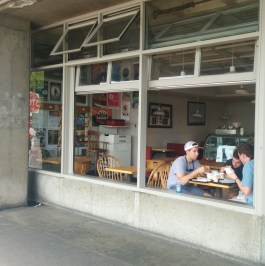
Last weekend I even went to Pike Market to scope out the territory, where Sinclair sits as he watches Beryl. And you thought I just dumped a couple of random pictures into this post. The one jpeg is potentially where Sinclair would sit [a coffee shop across the street from the end of the market] and his view from said coffee shop.

IMG_20140608_135725

So I ask myself, does this count as writing? Does building characters and walking around, photographing their life, their microcosm count as writing?

For now, I’m telling myself yes, this does count as writing. I’m building the characters in my head, building their stories. And to be honest, this is the fun part of writing. I love creating people. I love investing enough of the thought process in them that they become real, at least in my head. I can see both of them, can hear their voices, can feel their pain. Because you know if I write it, it isn’t going to be some fun beach read.

Did I mention that self-deception is one of my virtues?

Book Blurbs are Hard

AUWJust recently, I queried Indies Unlimited about listing my book as one of their Featured Books. Everything about my book passed muster with flying colors [cover, reviews, author pages, preview], everything except the book blurb. Kat, who has been very helpful, said that my book blurb is confusing. And to be honest it is/was. Mostly because I know what the book is about, but condensing it down into 200 or so words is more difficult than I imagined.

The problem is that An Untold Want is a women’s literary novel, not a romance, nor is it a urban-fantasy, even though it has witches and ghosts. And a young suitor.

Maggie is the main character, and she has issues, with everything, especially her family heritage. She grew up in a world where gossip is truth, and image is everything. Witch is not the story. It’s a factor in the story. Same when it comes to romance.

So I don’t want to represent it as an urban-fantasy[or romance] novel. Yes, there are witches. Yes, there is a relationship, actually several of them in the book, but calling it an urban-fantasy or romance novel is missing the mark by a long shot, and misleading the reader. It’s about three women finding their self-worth. The romance and witches are elements used to make it a deeper, more well-rounded story.

I’m frustrated with myself, with how difficult it is to put all that into 200 or so words, to get the tone just right so that the potential reader will want to purchase it and be happy with their purchase. You see, I bought into the whole idea of cross-genre books that people like Donald Maass are pitching, because it sounds like the best of all worlds, but in general the reader population hasn’t really bought into it.  They see witches and think urban fantasy.  Same when it comes to romance.

So how do I write a book blurb that expresses all of that without putting off the reader, without it coming across as boring or condescending? I can’t write: This is a book about witches and love, but it’s not about witches and love.

Today, I contacted Lisa, my editor and friend. We reviewed the advice Kat gave me, which Lisa backed wholeheartedly, and we worked on re-writing my book blurb. I’m on about my tenth re-write, with Lisa, as she says, adjusting my direction.

This is what I’m going to submit to Kat:

Being born into a family of witches in a small Georgia town is more than enough to brand Maggie MacAllister a social pariah. In the fifteen years since she came home from college with a PhD, baby Liz, and no husband, she has withdrawn from life, from a world where gossip is truth and image is all that matters.

Maggie just wants a normal life, maybe even a husband, but everyone knows that any man who falls for a MacAllister woman dies in the prime of life. So, even though Maggie sees herself as a rational, science-minded person, her family and its history weighs on her, colors her life in deep shades of loneliness and self-doubt.

When a medical emergency befalls her daughter, Maggie is forced to examine the choices she has made. Forced to let others into her rigid, cloistered lifestyle. Forced to recognize a potential, and younger, suitor. But will she be able to overcome her fear of what others think of her and accept her heritage? And if she does, will she be able to protect the people important to her from the small town dogma and drama and still find happiness?

If,  for whatever reasons, you’re having the same problems:

Lisa is now taking new clients if you’re looking for someone to help you polish your book [or book blurb], and the Indies Unlimited reference on writing book blurbs,  The Blurb Doctor is In, is an excellent starting place.

Rekindling the Fire

IMG_20140608_215810

Today, I went with a friend down to Pike Market. There they have this wonderful little witchy shop called Tenzing Momo. I go there every time I’m at the market, but because I was with a friend, I hadn’t planned on getting a tarot reading today. Having known me for a very long time, my friend suggested that I go ahead and get a reading, that she could easily entertain herself for half an hour in the market.

If you’ve ever had a card reading, or two, you know every reader has his/her own style. Add into equation the fact that I read cards, not professionally, but for fun, and, well, I just never know what I’m going to get. I’ve had some really good readings and some really silly — I won’t say bad, because, just  because — readings. Today’s was good.

As Tansy, in An Untold Want, says reading tarot cards is akin to pagan psychology. The cards are there to help the recipient of the reading get in touch with his/herself. The reader is (or should be) more of a guide.

We started out today with the reader asking my birth sign, Leo. She was surprised, said that it felt like I was more of a Water sign than a Fire sign. I don’t know that much about astrology, but I went with it. We talked for awhile about possible reasons. She said that I was allowing the Water in me to dampen down my Fire. What she said felt true. For a long time, I’ve felt like I have to suppress my personality to fit in. To make others happy instead of myself.

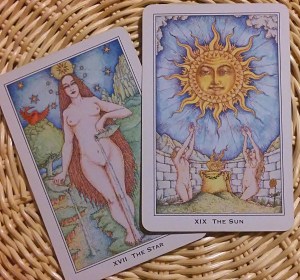
She then laid out the tarot cards. The beginning card was The Star and ending card was The Sun. In the picture I’ve posted, the cards are from the deck I use, the Nigel Jackson Tarot.  The reader at Tenzing Momo used a different deck. Sometimes the deck matters. Most times it doesn’t.  But even if you know nothing about tarot cards, you can probably surmise that these are both good cards.

There is a ton of symbolism in each image. So many things that can be interpreted, from the card number to the colors, to the elements represented, to the animals or scenery in the background. When you read the cards, all these things can be taken into account, or the reader can go with a general idea of what the card means to them. That’s why the deck matters sometimes. Anyway, I’ll give you the short version. In general The Star represents inspiration and renewed hope, while The Sun is all about the power of the light after a period of darkness. About regaining the fire.

About regaining the fire that I’ve quenched for too long worrying about what others want or need, putting their needs ahead of mine.

The reader said one other thing that really stuck with me. She said that I don’t have to produce anything. Not unless I want to.

I know it sounds silly that this was such a revelation, but sometimes I need someone to hit me over the head with it before I see what’s right in front of me. Lately I’ve been feeling so weighed down, worrying about this or that. Worrying about a promotion or a raise or just how I appear. [I have a lot of Maggie MacAllister in me, or vice-versa.] Worrying that I won’t be able to please everyone. Worrying that I can’t be all things to all people.

What I really need to do is write. Not because I have to. Not because I should do it. Just because I want to. Because it’s something that I enjoy, something that I do for me.

***

If you’d like to know more about Tarot cards/readings, this is a good place to start:  http://www.ata-tarot.com/resource/cards/

Or if you just want to play around with a reading or three, without having to buy a deck of cards or pay for a reading, this is a really good site:  http://www.facade.com/tarot/

Book.Review: The Goldfinch

IMG_20140606_184503

I picked up The Goldfinch by Donna Tartt because it sounded intriguing.  I’m trying to remember if it had already been designated a Pulitizer prize winner when I purchased it. What I do remember is that I very much enjoyed Ms. Tartt’s novel The Secret History and thought that this should be a good book too.

But this book, this book really tried my patience.  The story is good, some of the prose beautiful, but as so many of the Amazon reviewers stated, Ms. Tartt needed an honest editor. The Goldfinch should have been about 450 pages, not 750 pages. The (asides) started driving me crazy about two chapters in, and there are lots of them. So many that I started skipping over whole Kindle pages of text nested inside parentheses. Most added little to the story line. And finally after dragging myself though Potter’s –Theo Decker’s– miserable self loathing, what with his ability to take one minute of action and introspect it into thirty pages of mental gymnastics, I got near the end and Ms. Tartt apparently decided that parentheses weren’t enough.  At about the 98% mark on the Kindle, I ran into this artificial construct:

[As for Pippa: ………  three pages more ] new paragraph [You can have either… another page] pages of regular text [That little guy… a BUNCH more pages] and so on.

BTW, there are parentheses’d asides inside this ridiculous formatting choice. I say ridiculous, because I still can not figure out what the brackets are supposed to indicate.

I almost quit reading. At 98% finished, I almost quit reading.

If you knew me better, you’d realize that it takes a lot for me to leave a book unfinished. You’d realize that I love long complicated sentences. I love f’ed up, unlikable characters.  That I write long complicated sentences about unlikable characters, sentences which often get dinged, by readers and teacher, for being too long, too complicated, or too introspective.  In my books, I don’t use asides contained within parentheses. Yes, I frequently do so in my blog, but my blog posts are short, and the asides do not stop the flow of the story, which Ms. Tartt does frequently with these unnecessary aside. I don’t even like it when Stephen King does (asides), and he owns my heart.

So even though I, too, write these long, complicated sentences about unlikable characters, quite a few times I considered just tossing The Goldfinch. In 750 pages, the only interesting character is Boris, and in many places she has made him quite two-dimensional. All the other characters are predictable, except for maybe Welty. Sadly, Welty played a very small part in the book.

So what I’m asking myself is how this book won a Pulitzer. It’s a formatting nightmare. The plot is interesting, but the characters are stereotypical at best. The protagonist is detestable, often boring in his continual mental-flagellation. And with fifteen pages left to read, I don’t believe that he’s changed.  Ms. Tartt even pulled a deus ex machina when she has Boris sweep in and save the day, apparently so that Theo doesn’t have to change.  With fifteen pages to go, I still feel like Theo — Theo, whose name translates into god in Greek — is rationalizing his mistakes. A god he is not. Not even Dionysus. Dionysus isn’t that whiny. I think I would have preferred an ending where Boris didn’t show up to save the day.

I’m still considering whether I want to bother and read those last fifteen pages. I probably will, but only to see if anything gets any better. I’m not holding my breath.

This book had so much potential, from it being written by a brilliant author to the brilliant plot. But it appears that Ms. Tartt’s ego is bigger than her common sense or her editor’s persuasion ability.  I’m giving The Goldfinch 3-stars, because of my rating system, and because I’m trying to be generous. Of the nine thousand plus reviews on Amazon, nearly a nine hundred of them are one-star reviews, and over a thousand are two-star reviews. So I am being more generous than many.

As a reader, I doubt I will invest the time in another of Ms. Tartt’s novels. As a writer, I’m perplexed that something like this could win a Pulitzer. As a new author, I know that if I had written this novel, I wouldn’t have gotten an agent or publisher to look twice at it.

If you’ve read it, I’d love to hear your opinion and why you hold that opinion.

#AmazonCart – Shopping from Twitter??

According to an article on CNET (Amazon, Twitter link up for easy shopping through #AmazonCart), Twitter users can now link their Twitter and Amazon account, allowing them to add items to their Amazon cart directly from Twitter.

It sounds like a great idea for those of us who are basically unknown authors. Right? Now when I pitch my novels on Twitter, someone reading my post doesn’t have to remember to go to Amazon to purchase it.

But having read The Circle by Dave Eggers, I am concerned about how all of my accounts are being linked. How all my information is now being stored in a huge data vault in a cloud somewhere, where companies like Amazon can mine information about me, can suggest items I should purchase. It’s already happening. Data mining has been around for years, literally.

Maybe that’s why after reading The Circle, even FaceBook creeped me out for awhile, because we willingly are moving in that direction, to a place, a society where no one will have privacy anymore. And we’re doing it to ourselves. Don’t get me wrong, I’m all for convenience–I love the digital world, what with on-line shopping and banking, and I don’t want to go off the grid–but I also enjoy my ability to turn it off when I want to.

Your thoughts?


Book Cover Colors??

IMG_20140601_185313A FaceBook friend posted a link today that has me pondering the effect of color on the human psyche.

The article is Roses are Red, Violets are Blue: Here’s How Color Affects You. The premise of the article is that because “42 percent of males and 30 percent of females around the globe claim [blue]’s their color of choice” many savvy marketing firms use blue as a primary color in their logos. Followed by red and green, or combinations of primary colors. Now think about it, about all the logos you see everyday and about how many of them use primary colors.

Having worked for Big Blue for many years, where the corporate indoctrination class used to be called “Paint ’em Blue,” well, I got to thinking seriously about it. And the corporation I currently work, their logo is mostly red, but yes, there’s the blue, drawing the eye as if it were flashing come buy something.

So does this preference for colors also filter down into the publishing world? Do books with blue color schemes sell better? I’d love to see statistics on how many books have blue as their primary cover color.  [If anyone out there knows of an article regarding cover colors, please reply to this post.]

Both of my books have black on beige color schemes, which I like, but I wonder if they would attract more attention if they were blue. And red or green. Or yellow. When my next novel is ready to publish, I’m really going to have to play with brighter colors. Hey, every little bit helps.

By the way, if you could take a peek in my closet, you’d see that my favorite color, unlike 30 percent of females, is black. Yes, my favorite color is also the favorite color of many serial killers. Or so I’ve been told.

Fresh Start

Lately, I’ve stalled in my writing efforts. I’ve let lots of things get in the way, including a soul-sucking 9-5 job, but I’m coming back. Not as quickly as I’d like, but this new website is an indication that I’m starting to build steam again. For the past couple of years, I’ve told myself that I’d put together a website, more than a blog, and I kept putting it off because it seemed like such an effort.  But I did it.  Over the past week, I’ve built a website that I hope represents me.  The theme is elegant grunge which sort of sums up my whole personality.

I’ve also been writing some of the back story for my new novel [working title: the twins]. And I believe, after several iterations, that I have finally developed Beryl’s voice. Part of my hesitation is that with An Untold Want, I went through several re-writes, changing the tense or the PoV. This time, I want to know if Beryl is going to speak or if the story will be third person, before I write a majority of the book. And it’s looking like this will be a first-person/past-tense story which is totally different than An Untold Want.  This book will be more like Couillon in style, a little more fast paced than An Untold Want, but still falling into the literary genre.